Vol. 03The Companion

"A spectre is haunting Europe — the spectre of communism."

— Karl Marx & Friedrich Engels, opening line of The Communist Manifesto, London, February 1848

Comrade Companion

Before the question of "communism in America" is the question of where it came from, what happened to it on the way, and what was already here when it arrived. This companion is a study of thirty-two texts from a single library shelf — the working library of the Communist Party USA, NYC office, in the Chelsea neighborhood of Manhattan. The shelf holds three arcs in conversation. Session 01 — Origins. Engels in a Manchester slum in 1845; Marx and Engels in a London garret in 1848; the long argument from there into Lenin's Russia and Dimitrov's Comintern. Session 02 — Movement. What happened across the world from 1928 to 1987 as twelve liberation struggles took up Marx and remade him: Lima, Yan'an, Hanoi, Algiers, Havana, Accra, Bissau, Dar es Salaam, Soweto, Ouagadougou. Session 03 — Convergence. What happened when the canon arrived in the United States and met a Black radical tradition that was already a hundred years old. Three sessions, thirty-two primary sources, all in the public domain or in long-circulation movement archives.

Sessions 3
Sources 32
Site 235 W 23rd St, NYC
Companion by Radical Imagination

How to use this

The companion is built as a sequence: origins, movement, convergence. Session 01 traces what happened in nineteenth-century industrial Europe and twentieth-century revolutionary Russia that produced the body of work — what the world looked like to the people who wrote these books, what they were responding to, what they were trying to do. Session 02 follows that body of work as it crossed continents and was taken up — and substantially remade — by the anti-colonial liberation movements of the twentieth century. Session 03 picks up that doubly-translated work as it crossed the Atlantic again and met a U.S. Black radical tradition that was a hundred years old when it arrived. The bridges between sessions are explicit: Eighteenth Brumaire (S1.03) is the historical-materialist method Du Bois used in Black Reconstruction (S3.02); Lenin's "Theses on the National and Colonial Questions" (S1.08) is the Comintern document that authorized Harry Haywood's Negro Liberation (S3.03); Padmore (S2.05) advised Nkrumah (S2.08), and both fed back into the U.S. Black radical canon of S3.

Write into the reflection fields as you read. They save automatically to your browser — nothing leaves your device.

The three sessions

Session 01
Origins · the European Canon
Open →
Session 02
Movement · the Anti-Colonial Century
Open →
Session 03
Convergence · the Black Radical Canon
Open →

The curatorial position

This volume is built on five commitments — what gets in, what stays out, and why.

  1. Origins, movement, arrival. Read what the world looked like to the people who wrote these books before reading what U.S. radicals did with them — and read what every liberation struggle in between did with them on the way.
  2. The room is the source. Every text in this companion was on a shelf, on a wall, or on the desk in the working library of CPUSA NYC, photographed in May 2026. The room is the curatorial principle.
  3. Public domain or fair use. All thirty-two texts are in the public domain, in long-circulation movement archives (marxists.org, Internet Archive controlled digital lending), or quoted only at fair-use length with link to the full text. Nothing is paywalled.
  4. Lead with the writer's actual sentences. Every chapter opens with primary text — translator credited, edition cited — before any commentary. The work is not the explanation; the work is the encounter.
  5. The wall is also a source. Where a portrait on the CPUSA Chelsea wall corresponds to a writer in this volume, the photograph of that wall is part of the bibliography.

What this companion does not do

It does not stand in for the books. It is companion to encounter, not substitute. Where the source lives in print, buy or borrow it from your local library or independent bookstore. It does not interpret on your behalf. The framing is brief. The work is the encounter.

It does not endorse, recruit for, or report from any political party — Communist, Socialist, Democratic, Republican, or otherwise. Radical Imagination is a Cultural Technology Studio. The position of this volume is that the books in this room are part of the U.S. literary and intellectual record, and that the world-historical movement they document is part of the global intellectual record. They have been kept honestly by the people who kept them. That is enough reason to read them.

Session 01 · Origins

The European Canon

Manchester · London · St. Petersburg · Leipzig · Moscow · 1845–1935 · what the world looked like before the books arrived

Ten texts, ninety years, four men. We open in 1845 in a Manchester slum, where a 24-year-old German named Friedrich Engels — sent by his father to learn the family textile business — has spent two years walking working-class neighborhoods and recording what industrial capitalism looks like at street level. Three years later, he and Karl Marx will write the Manifesto. Sixty-nine years after that, V.I. Lenin will publish Imperialism from a small apartment in Zurich. Eighteen years after that, Georgi Dimitrov will pivot the world communist movement into a popular front against fascism, from a Moscow stage. The arc is the conditions that produced the work; the work that responded to those conditions; and the questions the work passed to the next generation. Two of these texts — Marx's Eighteenth Brumaire (S1.03) and Lenin's "Theses on the National and Colonial Questions" (S1.08) — are the bridges into Session 03, where U.S. Black radicals were waiting for them. The closing source — Dimitrov's 1935 popular-front speech — is the door that opens onto Session 02.

Source 01 · Reportage · Session 1

The Condition of the Working Class in England · Die Lage der arbeitenden Klasse in England
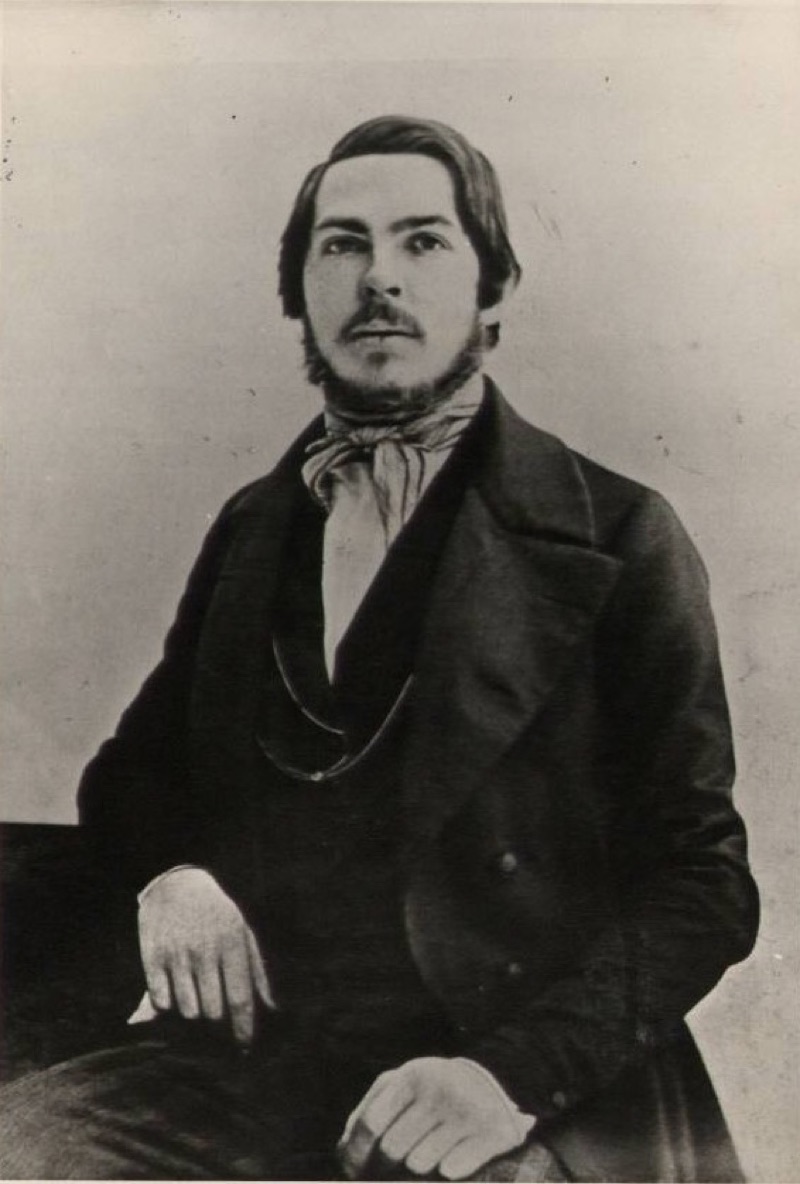
Friedrich Engels — 1820–1895. Written 1844–45, age 23–24, in Manchester, where he had been sent by his father (a Bremen textile manufacturer with a stake in the firm Ermen & Engels) to learn the family business. Original German edition: Die Lage der arbeitenden Klasse in England, Otto Wigand, Leipzig, 1845. First English translation by Florence Kelley Wischnewetzky, John W. Lovell, New York, 1887. Authorised English edition: Swan Sonnenschein, London, 1892, with a new preface by Engels. Now in the public domain in every jurisdiction.

Country · Manchester Form · Investigative reportage Year · 1845 / 1887 (EN) / 1892 (revised EN) Subject · The wound that produced the diagnosis
Friedrich Engels in his early twenties, daguerreotype circa 1840
Friedrich Engels · daguerreotype c.1840 · public domain

The Old Town of Manchester · what Engels saw

At the bottom flows, or rather stagnates, the Irk, a narrow, coal-black, foul-smelling stream, full of débris and refuse, which it deposits on the shallower right bank. In dry weather, a long string of the most disgusting, blackish-green, slime pools are left standing on this bank, from the depths of which bubbles of miasmatic gas constantly arise and give forth a stench unendurable even on the bridge forty or fifty feet above the surface of the stream. But besides this, the stream itself is checked every few paces by high weirs, behind which slime and refuse accumulate and rot in thick masses. Above the bridge are tanneries, bonemills, and gasworks, from which all drains and refuse find their way into the Irk, which receives further the contents of all the neighbouring sewers and privies.

— from Chapter 4, "The Great Towns," Florence Kelley Wischnewetzky translation, 1887. Engels at twenty-four describes the river that ran through the Manchester slum of Little Ireland — a working-class neighborhood of Irish immigrants, cotton-mill weavers, and dyers — at the height of the British industrial revolution.

The case file · the working day

A pretty list of diseases engendered purely by the hateful money-greed of the manufacturers! Women made unfit for childbearing, children deformed, men enfeebled, limbs crushed, whole generations wrecked, afflicted with disease and infirmity, purely to fill the purses of the bourgeoisie. And when one reads of the barbarities committed against the working-people, when one knows that the bourgeoisie permits and encourages this, one's heart trembles with rage and indignation against the class which calls itself "philanthropic," while it does its best to grind into the dust those whom it forced into the factory and the mine.

— from Chapter 9, "Single Branches of Industry — Factory Hands," after Wischnewetzky. Engels documented the medical literature of the British factory inspectorate, the parliamentary Blue Books, and his own clinical observation in working-class districts. Working-class life expectancy in Manchester in the early 1840s was, by his calculation and the official medical records, seventeen years for the urban poor and around thirty-eight for the wealthier inhabitants of the city — a gap that did not exist in the same form before the factory system.

The full text · Marxists Internet Archive

First-edition scan of the 1887 Wischnewetzky translation, freely viewable via Internet Archive. The Marxists Internet Archive (marxists.org) hosts the complete text in HTML, searchable. The 1892 Engels-revised English edition adds a preface in which Engels — at 72, three years before his death — reflects on what had and had not changed in the half-century since publication.

The reporter

Born 1820 in Barmen (now Wuppertal), Prussia, into a wealthy German textile family. Sent to Manchester in late 1842, age 22, to learn his father's textile business at Ermen & Engels. Spent two years walking the working-class districts of Manchester, Salford, and Bradford with his Irish working-class partner Mary Burns as guide. Returned to Germany in 1844; met Marx in Paris that summer; the friendship and intellectual partnership lasted until Marx's death in 1883 and Engels's in 1895. Funded Marx and Marx's family from textile-business profits for nearly forty years. Edited and published Volumes II and III of Capital from Marx's manuscripts after Marx's death. Wrote Anti-Dühring (1878), The Origin of the Family, Private Property and the State (1884), and the late prefaces and revisions that shaped how a century of socialists read Marx.

Why this voice

Before there is a Manifesto there has to be a wound. Engels at twenty-four walked the working-class districts of Manchester for two years and recorded — street by street, factory by factory, tenement by tenement — what industrial capitalism looked like at ground level. Eighteen-hour shifts. Children of seven on the looms. Tuberculosis-saturated cellars. Working-class life expectancy in Manchester at seventeen. Marx read the book the year after publication; it gave him the empirical floor he had been missing. Three years later they wrote the Manifesto together. The Condition of the Working Class is the answer to "what happened in the world that made communism feel necessary." Engels did the journalism that turned moral indignation into a case file. Walter Rodney did the same for Africa 127 years later (S2.10); the method is the same.

Carry it

1 · Walk three blocks of your neighborhood at street level the way Engels walked Manchester. What does the working day actually look like? Write what you saw — names of streets, names of businesses, names of jobs.

Unsaved

2 · Engels was 24, the son of his class's beneficiaries, walking the streets where his class's profits came from. What walk would the equivalent journey for you be?
Unsaved

Source 02 · Pamphlet · Session 1

The Communist Manifesto · Manifest der Kommunistischen Partei

Karl Marx (1818–1883) and Friedrich Engels (1820–1895). Commissioned by the Communist League at its Second Congress, London, December 1847. Written in Brussels in late January–early February 1848. First published in German, London, February 1848 — three weeks before the February Revolution erupted in Paris. First English translation by Helen Macfarlane, The Red Republican, London, 1850. Standard English translation by Samuel Moore, supervised by Engels, 1888. Now in the public domain in every jurisdiction.

Country · Brussels · London Form · Pamphlet · 23 pages Year · 1848 · 1888 (standard EN) Status · Fully public domain
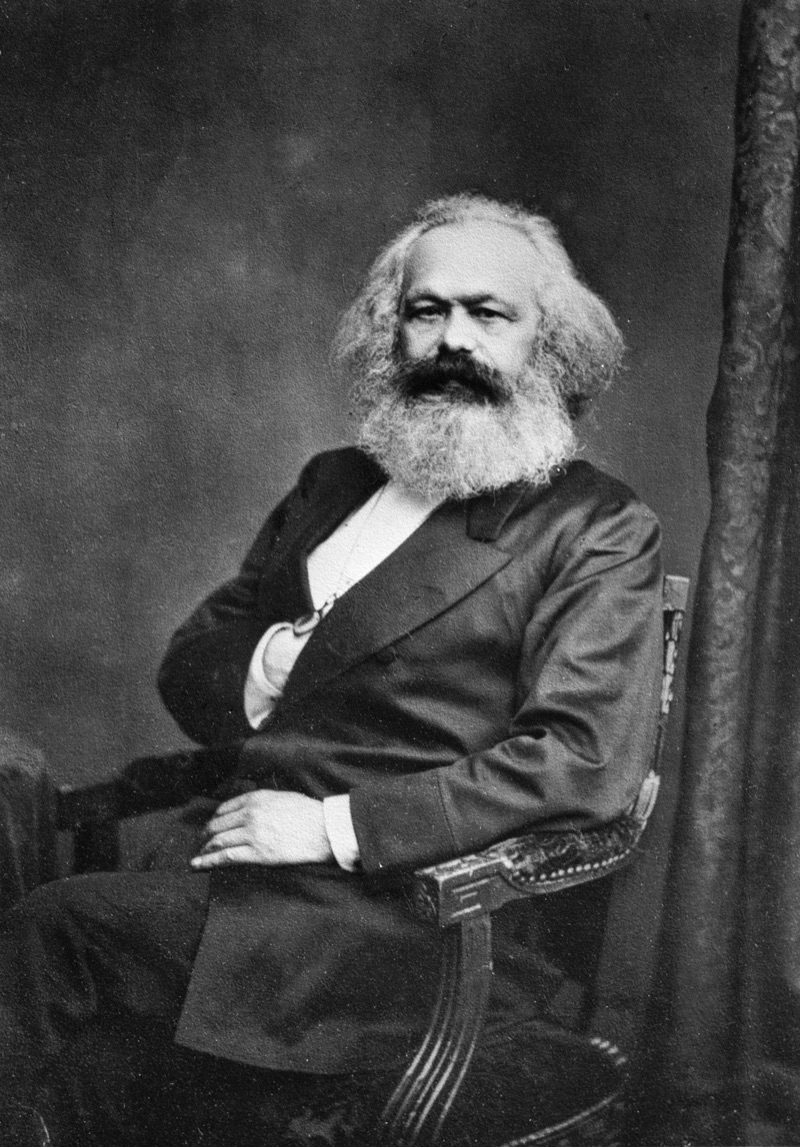
Karl Marx, photographed in 1875 by John Mayall
Karl Marx · 1875 photo by John Mayall · public domain

The opening · the spectre

A spectre is haunting Europe — the spectre of communism. All the powers of old Europe have entered into a holy alliance to exorcise this spectre: Pope and Tsar, Metternich and Guizot, French Radicals and German police-spies.

Where is the party in opposition that has not been decried as communistic by its opponents in power? Where is the opposition that has not hurled back the branding reproach of communism, against the more advanced opposition parties, as well as against its reactionary adversaries?

— Preamble, Samuel Moore translation supervised by Engels, 1888. The most-quoted opening in modern political prose. Pope Pius IX and Tsar Nicholas I named together — Catholic Europe and Orthodox Europe in shared panic. Metternich (Austria) and Guizot (France) were the two most powerful conservative statesmen on the continent at the moment of writing. The Manifesto opened with a roll-call of its enemies.

Section I · the history of class struggles

The history of all hitherto existing society is the history of class struggles.

Freeman and slave, patrician and plebeian, lord and serf, guild-master and journeyman, in a word, oppressor and oppressed, stood in constant opposition to one another, carried on an uninterrupted, now hidden, now open fight, a fight that each time ended, either in a revolutionary re-constitution of society at large, or in the common ruin of the contending classes.

— Section I, "Bourgeois and Proletarians," opening. Engels added a footnote in the 1888 English edition: "That is, all written history. In 1847 the prehistory of society, the social organisation existing previous to recorded history, was all but unknown." The footnote acknowledged the work of Lewis H. Morgan on Iroquois clan structures and pointed forward to Engels's own Origin of the Family, Private Property and the State (1884).

The closing · the slogan

The Communists disdain to conceal their views and aims. They openly declare that their ends can be attained only by the forcible overthrow of all existing social conditions. Let the ruling classes tremble at a Communistic revolution. The proletarians have nothing to lose but their chains. They have a world to win.

Working Men of All Countries, Unite!

— Section IV, closing lines. The slogan that closed the pamphlet became the closing slogan of every communist gathering, document, congress, and demonstration for the next 175 years. Engels noted that Marx wrote the closing alone at high speed under the printer's deadline.

The full text · Marxists Internet Archive

A scanned bilingual edition viewable via Internet Archive. The Marxists Internet Archive (marxists.org) hosts the standard 1888 Moore-Engels English translation in HTML, the original 1848 German, and dozens of other-language translations. The pamphlet is in the public domain everywhere; it has been printed in more languages and editions than any text in modern political history except the Bible.

The authors · 1848

Karl Marx was 29; Friedrich Engels 27. They had met four years earlier in Paris and had been collaborating intellectually ever since. Both were exiles — Marx from Prussia (his journalism had been suppressed in 1843), Engels from a respectable German textile family that had sent him to Manchester to learn the trade (which produced S1.01). The Communist League — a small, mostly émigré workers' association of about a thousand members — commissioned them to draft a public statement of the League's principles. Marx wrote it under deadline pressure in late January 1848 in Brussels, drawing on Engels's earlier Principles of Communism. The pamphlet was rushed to a London printer in early February. Three weeks after publication, the February Revolution erupted in Paris. Within months, uprisings were burning across Italy, Germany, Austria, Hungary. The Manifesto did not cause 1848 — but it named the social force that 1848 was already releasing.

Why this voice

The most-distributed political pamphlet in human history, written by two men in their twenties, on commission, in six weeks, to a deadline. The opening sentence is the most-quoted in modern political prose. The closing line is the first slogan of the modern left. Every text in this session — and most of Sessions 02 and 03 — is in some way a footnote to this one. The pamphlet is short enough to read in an afternoon and dense enough to spend a lifetime returning to. It is the floor on which the rest of the volume stands.

Carry it

1 · Write the opening sentence of a manifesto for what your community is facing today. Match the Manifesto's syntax: a noun, a verb of motion, the named subject, a list of named enemies.

Unsaved

2 · The closing slogan calls workers across borders to unite. What is the slogan that would close your manifesto? What collective does it call?

Unsaved

Source 03 · History · Session 1 · Bridge text → S3.02

The Eighteenth Brumaire of Louis Bonaparte · Der achtzehnte Brumaire des Louis Bonaparte

Karl Marx — written between December 1851 and March 1852 in London exile, in direct response to the 2 December 1851 coup of Louis-Napoléon Bonaparte (President of France 1848–1852, then Emperor Napoleon III 1852–1870). First published in serial form in Die Revolution, the émigré German-language journal edited by Joseph Weydemeyer, New York City, May 1852. First English translation by Daniel De Leon, 1898. Now in the public domain.

Country · London · published in New York Form · Historical analysis Year · 1852 Method · Historical materialism, in operation
Karl Marx, photographed in 1875 by John Mayall
Karl Marx · 1875 photo by John Mayall · public domain

The opening · tragedy and farce

Hegel remarks somewhere that all great world-historic facts and personages appear, so to speak, twice. He forgot to add: the first time as tragedy, the second time as farce. Caussidière for Danton, Louis Blanc for Robespierre, the Montagne of 1848 to 1851 for the Montagne of 1793 to 1795, the nephew for the uncle. And the same caricature occurs in the circumstances of the second edition of the eighteenth Brumaire.

Men make their own history, but they do not make it as they please; they do not make it under self-selected circumstances, but under circumstances existing already, given and transmitted from the past. The tradition of all dead generations weighs like a nightmare on the brains of the living.

— Opening of Section I, Saul K. Padover translation. Two of the most-quoted sentences in modern political prose. The "uncle" is Napoleon Bonaparte, who staged the original coup of 18 Brumaire (9 November 1799). The "nephew" is Louis-Napoléon, who staged its caricature — the 2 December 1851 coup — and crowned himself emperor a year later.

The method · how to read a political event

The peasants find their representative in the executive power that subordinates society to itself. Their political influence, therefore, finds its final expression in the executive power subordinating society to itself. They cannot represent themselves, they must be represented. Their representative must at the same time appear as their master, as an authority over them, as an unlimited governmental power that protects them against the other classes and sends them rain and sunshine from above. The political influence of the small-holding peasants, therefore, finds its final expression in the executive power subordinating society to itself.

— from Section VII. Marx's analysis of how a class can hold political power without holding political voice — the small French peasantry's relationship to Bonaparte's regime — is the most-cited passage of the work after the opening. The line "they cannot represent themselves, they must be represented" was made famous a second time by Edward Said as the epigraph to Orientalism (1978).

The full text · Marxists Internet Archive

First English edition (Daniel De Leon translation, 1898) viewable via Internet Archive. The Marxists Internet Archive hosts the standard Padover and Saul translations in HTML, fully searchable. The pamphlet is short — under 100 pages — and reads as a real-time political diary of the months in which a French republic became an authoritarian empire.

The historian

Marx was 33, in his fifth year of London exile after expulsion from Prussia, France, and Belgium for his journalism. He was living in poverty in two rooms on Dean Street in Soho with his wife Jenny and three children; a fourth child, Franziska, would die that April of bronchitis. Marx wrote the analysis as it happened: news arrived from Paris by ship and rail; he and Engels read everything they could get; he composed the chapters by candlelight in the British Museum reading room and at home. The work was published in New York by his friend Joseph Weydemeyer because no German-language press in Europe would touch it. Marx was paid 24 dollars for it.

Why this voice

The bridge text. Marx's analysis of the Bonaparte coup is the working demonstration of historical materialism — class forces, state structures, the role of ideology — applied to a single political event in real time. Reading The Eighteenth Brumaire is reading the method get used; reading Capital (S1.04) is reading the method having been used to produce a system. Reading forward: W.E.B. Du Bois drew on this method directly for Black Reconstruction (S3.02) eighty-three years later — the same instrument applied to the U.S. Civil War. Read these two together. The same instrument, two countries, eight decades apart, the same insight: that history is made by classes who do not get to choose the conditions under which they make it.

Carry it

1 · Take a recent political event from this past year and read it the way Marx reads the Bonaparte coup — class forces, state structures, the role of ideology, who is "represented" by whom. What appears that the news did not show?

Unsaved

2 · "The tradition of all dead generations weighs like a nightmare on the brains of the living." What dead generations weigh on yours? What rituals of the dead does your political moment keep performing?

Unsaved

Source 04 · Political Economy · Session 1

Capital, Volume I · Das Kapital, Buch I · Der Produktionsprozess des Kapitals

Karl Marx — written over fifteen years (1857–1867), most of them spent in the British Museum reading room. First published in German by Otto Meissner, Hamburg, September 1867 — the only volume Marx finished in his lifetime. Volumes II (1885) and III (1894) were edited and published posthumously by Engels from Marx's manuscripts. English translation by Samuel Moore & Edward Aveling, edited and with a preface by Engels, Swan Sonnenschein, London, 1887. Now in the public domain.

Country · London · published in Hamburg Form · Political economy Year · 1867 / 1887 (EN) Subject · The capitalist mode of production
Karl Marx, photographed in 1875 by John Mayall
Karl Marx · 1875 photo by John Mayall · public domain

The opening · the commodity

The wealth of those societies in which the capitalist mode of production prevails, presents itself as "an immense accumulation of commodities," its unit being a single commodity. Our investigation must therefore begin with the analysis of a commodity.

A commodity is, in the first place, an object outside us, a thing that by its properties satisfies human wants of some sort or another. The nature of such wants, whether, for instance, they spring from the stomach or from fancy, makes no difference.

— Chapter 1, Section 1, "The Two Factors of a Commodity: Use-Value and Value," Moore-Aveling translation, 1887. Marx opens not with capital, not with class, not with revolution — but with the smallest unit of the system: the commodity. The book builds outward from there. By the closing chapters it has analyzed the entire mechanism of capitalist accumulation through the everyday object the reader is holding.

The working day · what surplus value looks like

The capitalist has bought the labour-power at its day's value. To him its use-value belongs during one working-day. He has thus acquired the right to make the labourer work for him during one day. But, what is a working-day?

At all events, less than a natural day. By how much? The capitalist has his own views of this ultima Thule, the necessary limit of the working-day. As capitalist, he is only capital personified. His soul is the soul of capital. But capital has one single life impulse, the tendency to create value and surplus-value, to make its constant factor, the means of production, absorb the greatest possible amount of surplus-labour.

Capital is dead labour, that, vampire-like, only lives by sucking living labour, and lives the more, the more labour it sucks.

— Chapter 10, "The Working-Day," Section 1. The most quoted passage of Capital after the opening. Marx's central image: capital as the dead labor of past workers stored up in machines, mines, and ledgers — only made to "live" again by the present working day extracted from the present worker. The image carries forward into Lenin's Imperialism (S1.05) and Rodney's How Europe Underdeveloped Africa (S2.10).

The full text · Marxists Internet Archive

First English edition (1887) viewable via Internet Archive. The Marxists Internet Archive hosts the complete Moore-Aveling-Engels English text in HTML, the original German, and dozens of other-language translations. The book on the desk in Chelsea — photographed in May 2026 — was an illustrated Chinese edition: 一个中国人画《资本论》 ("A Chinese Person's Painting of Capital"), a 2017 reading-by-Chinese-artist series that puts Marx's text in dialogue with classical Chinese figure painting.

The economist

Marx was 49 when Volume I appeared. He had been working on the project since 1857 — in poverty, in the British Museum reading room, while supporting his family on Engels's textile-business profits and on what little journalism he could place. The Moore-Aveling 1887 English translation was overseen by Engels two years after Marx's death; it became the standard English-language Capital for the next century. Volume II (on circulation) was edited from Marx's manuscripts by Engels and published in 1885; Volume III (on the rate of profit, finance capital, ground rent) followed in 1894 — the year before Engels's own death. The collected works in the photographed Chelsea library include all three volumes plus Theories of Surplus Value (the so-called Volume IV), edited by Karl Kautsky from Marx's notebooks 1905–10.

Why this voice

Marx's central work — the analysis of capital as a social relation, of value, of surplus value, of the working day, of accumulation. The book is read in every left tradition on earth, has been translated into more than a hundred languages, and remains the most ambitious description of capitalist economics ever attempted. The Chinese illustrated edition photographed on the Chelsea desk is one piece of evidence that the work continues to be remade by every new tradition that takes it up. Reading the opening chapter of Capital alongside Engels in Manchester (S1.01) is reading the wound and the diagnosis on facing pages.

Carry it

1 · Pick one commodity in your hand right now. Trace the working day inside it. Whose hands? How many hours? At what wage? Until the chain stops yielding names.

Unsaved

2 · "Capital is dead labour, that, vampire-like, only lives by sucking living labour." Identify one structure in your life that is dead labor — accumulated, stored, no longer alive — and one that is living labor. What is the relation between them?

Unsaved

Source 05 · Political Economy · Session 1

Imperialism, the Highest Stage of Capitalism · Империализм, как высшая стадия капитализма

V.I. Lenin (Vladimir Ilyich Ulyanov) — Russian Marxist organizer and revolutionary, 1870–1924. Written in Zurich, January–June 1916, in the second year of World War I; the Russian manuscript was smuggled to Petrograd via clandestine channels. First published in Petrograd by Zhizn i Znanie press, mid-1917, between the February and October revolutions. The official preface to the French and German editions was written by Lenin from Moscow in July 1920, four years after composition. English translation in long-circulation through Progress Publishers, Moscow, and International Publishers, New York. Now in the public domain.

Country · written in Switzerland for Russia Form · Pamphlet · "popular outline" Year · 1917 / 1920 (revised preface) Subject · Capitalism's late-stage world-system
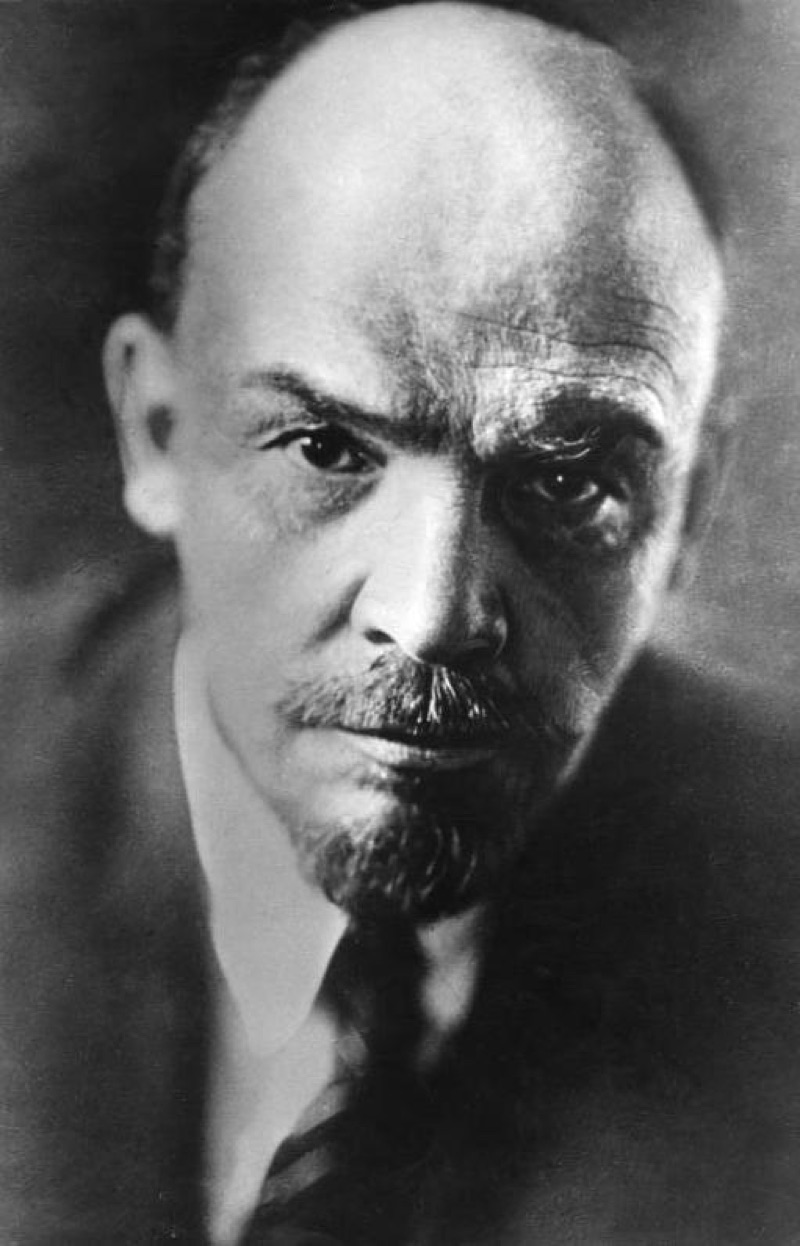
V.I. Lenin photographed in 1920
V.I. Lenin · 1920 · Bundesarchiv · public domain

The five characteristics · Lenin's definition

If it were necessary to give the briefest possible definition of imperialism we should have to say that imperialism is the monopoly stage of capitalism. Such a definition would include what is most important, for, on the one hand, finance capital is the bank capital of a few very big monopolist banks, merged with the capital of the monopolist associations of industrialists; and, on the other, the division of the world is the transition from a colonial policy which has extended without hindrance to territories unseized by any capitalist power, to a colonial policy of monopolistic possession of the territory of the world, which has been completely divided up.

Imperialism, in its specifically capitalist phase, is characterized by the following five features:

1) The concentration of production and capital has developed to such a high stage that it has created monopolies which play a decisive role in economic life;
2) The merging of bank capital with industrial capital, and the creation, on the basis of this "finance capital", of a financial oligarchy;
3) The export of capital as distinguished from the export of commodities acquires exceptional importance;
4) The formation of international monopolist capitalist associations which share the world among themselves;
5) The territorial division of the whole world among the biggest capitalist powers is completed.

— from Chapter VII, "Imperialism as a Special Stage of Capitalism." The five-point definition is the most-cited single passage in twentieth-century Marxist political economy. Every later anti-imperialist tradition — Mao (S2.02), Padmore (S2.05), Che (S2.06), Fanon (S2.07), Nkrumah (S2.08), Cabral (S2.09), Rodney (S2.10), Lumumba — works from these five points.

The full text · Marxists Internet Archive

A Progress Publishers (Moscow) English edition viewable via Internet Archive. The Marxists Internet Archive hosts the complete Russian and English texts in HTML, fully searchable. Lenin subtitled the work "a popular outline" — he wrote it for working-class audiences, not academic specialists. It is short, dense, and deliberately accessible.

The author · 1916

Lenin was 46, in his second decade of exile. He had spent most of the previous twelve years in Geneva, Paris, and Krakow, then moved to Zurich in February 1916 with his wife, Nadezhda Krupskaya, where they lived above a sausage shop on Spiegelgasse. He worked daily in the Zurich Public Library and the Cantonal Library, reading every available study of European finance capital and colonial expansion: Hobson's Imperialism (1902), Hilferding's Finance Capital (1910), the German banking literature, the British colonial Blue Books, the French radical press. The pamphlet was his synthesis, written under wartime Swiss censorship, and smuggled to Petrograd in pieces. Eight months after publication, Lenin returned to Russia in the famous "sealed train" through Germany. Six months after that, he led the October Revolution.

Why this voice

Fifty years after Marx's Capital (S1.04), Lenin asks what capitalism has become. The answer: concentrated, monopolistic, financialized, and global. Capitalism's drive to accumulate had pushed it into a world-system organized around colonial extraction; World War I, then halfway through its slaughter, was that system tearing itself open. The pamphlet is the bridge from Marx's analysis of the factory floor to the twentieth century's analysis of the colony, the bank, and the world market. Without Imperialism, the entire anti-colonial canon of Session 02 has no theoretical foundation. With it, the line from Engels in Manchester (S1.01) to Rodney in Dar es Salaam (S2.10) becomes legible as a single argument extended across a hundred and thirty years.

Carry it

1 · Lenin's five characteristics describe capitalism in 1916. Apply each one to capitalism in 2026 — concentration, finance/industry merger, capital export, international monopolist associations, territorial division. What still applies? What needs amending?

Unsaved

2 · Where is the colonial extraction that pays for your daily comfort happening right now? Name a country, a mineral, a hand.

Unsaved

Source 06 · Theory · Session 1

The State and Revolution · Государство и революция

V.I. Lenin — written in hiding in Razliv (a forest hamlet near Petrograd) and then in Helsingfors (Helsinki), August–September 1917, in the four-month interval between the July Days uprising in which the Bolsheviks were nearly destroyed and the October Revolution he would lead three weeks after the manuscript was finished. Subtitled "The Marxist Theory of the State and the Tasks of the Proletariat in the Revolution." Published in Petrograd, 1918. Now in the public domain.

Country · Razliv · Helsingfors · for Russia Form · Theoretical pamphlet Year · 1917 / pub. 1918 Subject · The Marxist theory of the state
V.I. Lenin photographed in 1920
V.I. Lenin · 1920 · Bundesarchiv · public domain

The opening · what the state is

The state is a product and a manifestation of the irreconcilability of class antagonisms. The state arises where, when and to the extent that class antagonisms objectively cannot be reconciled. And, conversely, the existence of the state proves that the class antagonisms are irreconcilable.

— Chapter I, Section 1, opening of the substantive argument. Lenin frames the entire pamphlet around a single insight from Engels's The Origin of the Family, Private Property and the State (1884) — that the modern state is not above class society but its product. The pamphlet's task is then to read what every text Marx and Engels wrote on the state actually says.

The argument · "smash the state machine"

The proletariat needs the state, this is repeated by all the opportunists, social-chauvinists, and Kautskyites, who assure us that this is what Marx taught. But they "forget" to add that, in the first place, according to Marx, the proletariat needs only a state which is withering away, i.e., a state so constituted that it begins to wither away immediately, and cannot but wither away. And, secondly, the working people need a "state, i.e., the proletariat organized as the ruling class."

The state is a special organisation of force; it is an organisation of violence for the suppression of some class. To replace the old "ready-made state machine" by a "new one," organising the armed forces of the proletariat, is exactly the meaning of "the dictatorship of the proletariat" — a transitional state, a state that is "no longer the state in the proper sense of the word."

— Chapter II, Section 3, working through Marx's Critique of the Gotha Programme (1875) and Engels's Letter to Bebel (1875). Lenin's central claim — that the workers' revolution must dismantle the existing state apparatus rather than capture it — is the argument that separates Bolshevism from social democracy. Twenty days after this manuscript was completed, Lenin's faction did exactly that in Petrograd.

The full text · Marxists Internet Archive

A scanned edition viewable via Internet Archive. The Marxists Internet Archive hosts the complete Russian and English texts in HTML. The pamphlet is short — under 150 pages — and reads as a working textbook of Marxist state theory annotated by a man with three weeks left before he is going to test the theory in practice.

The fugitive theorist

Lenin was 47. After the failed July Days uprising of 3–7 July 1917 (the Bolsheviks' first attempt to take power, crushed by Provisional Government troops), the Petrograd press denounced Lenin as a German spy and Kerensky's government issued a warrant for his arrest. He went underground. From 9 July to 8 August he hid in a peasant hut at Razliv on the Gulf of Finland, disguised as a Finnish field-hand. From 9 August to 7 October he hid in a Helsingfors apartment under the protection of a Finnish Social Democratic family. He spent the four months writing — including the unfinished manuscript that became State and Revolution. He returned to Petrograd, in disguise, on 7 October, and led the October Revolution sixteen days later.

Why this voice

Written by a man on the run, three weeks before he led a revolution. The book is Lenin's reading of Marx and Engels on what the state is, what proletarian revolution does to it, and what comes after. The argument is brutal in its simplicity: the modern state is an instrument of class rule, and a workers' revolution must dismantle it, not capture it. Reading State and Revolution alongside what actually happened in the Soviet Union after 1924 is a self-contained education in the gap between theory and history. Reading it alongside Patterson's We Charge Genocide (S3.06) is a self-contained education in what U.S. Black radicals had decided about the U.S. state by mid-twentieth century.

Carry it

1 · Where in your life has the state acted on you as an instrument of class rule? Where as a public servant? Be specific — which agency, which encounter, which day.

Unsaved

2 · Lenin argues the existing state apparatus must be dismantled, not captured. What apparatus in your life would you not capture but dismantle? What would you build in its place?

Unsaved

Source 07 · Letter · Session 1

Letter to American Workers · Письмо к американским рабочим

V.I. Lenin — written 20 August 1918, in the second year of the Russian Revolution, in direct response to the Allied intervention against Soviet Russia (U.S., British, French, Japanese, and Czech troops landed at Murmansk, Archangel, and Vladivostok in summer 1918). The letter was carried out of Russia by a returning American Quaker relief worker. First published in English in The Class Struggle magazine, New York, December 1918, and then circulated widely in the U.S. socialist and labor press. Now in the public domain.

Country · written from Moscow for the United States Form · Open letter Year · 1918 Audience · U.S. workers, organizers, labor press
V.I. Lenin photographed in 1920
V.I. Lenin · 1920 · Bundesarchiv · public domain

The opening · the salute

Comrades! A Russian Bolshevik who took part in the 1905 Revolution, and who lived in your country for many years afterwards, has offered to convey my letter to you. I have accepted his proposal all the more gladly because just at the present time the American revolutionary workers have to play an exceptionally important role as confirmed and principled opponents of American imperialism — the freshest, strongest and latest in joining in the world-wide slaughter of nations for the division of capitalist profits.

— Opening paragraph. Lenin frames the letter as one revolutionary writing to another set of revolutionaries — comrades — across a war his government is fighting against theirs. The Russian who carried the letter was Carl Sandburg's contact, a returning Russian-American Quaker named Peter Bogdanov.

Lincoln, Lenin · the U.S. tradition

The history of modern, civilised America opened with one of those great, really liberating, really revolutionary wars of which there have been so few compared to the vast number of wars of conquest which, like the present imperialist war, were caused by squabbles among kings, landowners or capitalists over the division of usurped lands or ill-gotten gains. That was the war the American people waged against the British robbers who oppressed America and held her in colonial slavery, in the same way as these "civilised" bloodsuckers are still oppressing and holding in colonial slavery hundreds of millions of people in India, Egypt, and all parts of the world.

About 150 years have passed since then. Bourgeois civilisation has borne all its luxurious fruits. America has taken first place among the free and educated nations in level of development of the productive forces of collective human endeavour, in the utilisation of machinery and of all the wonders of modern engineering. At the same time, America has become one of the foremost countries in regard to the depth of the abyss which lies between the handful of arrogant multimillionaires who wallow in filth and luxury, and the millions of working people who constantly live on the verge of pauperism.

— from the central section. Lenin reads the U.S. revolutionary tradition — the War of Independence, the Civil War, Lincoln, the abolitionists — back to U.S. workers as their inheritance. He names India and Egypt explicitly as the contemporary equivalents of colonial-era America. The argument: an American revolutionary who reads U.S. history seriously cannot support U.S. troops in Russia, India, or anywhere else.

The author · 1918, in office

Lenin was 48, ten months into the Soviet government, two months recovered from the Fanya Kaplan assassination attempt that had nearly killed him on 30 August 1918 — ten days after this letter was written. The Russian Civil War was at its height: Allied troops, including the American Expeditionary Force in Siberia (~8,000 U.S. soldiers under General William Graves) and the American North Russia Expeditionary Force at Archangel (~5,500 U.S. soldiers — known to the men themselves as the "Polar Bears"), were on Russian soil. Lenin wrote the letter to make a public-political case directly to U.S. workers over the heads of the U.S. press and the U.S. government. The letter circulated in U.S. socialist papers, contributed to the climate that produced the 1919 Seattle General Strike and the Palmer Raids, and is still on the curriculum of every U.S. left study group that takes Lenin seriously.

Why this voice

The shortest, most accessible Lenin in this session — and the one most directly addressed to the country in which the rest of the volume sits. Lenin writes to U.S. workers in the language of U.S. labor history: Lincoln, the abolitionists, the Knights of Labor, the IWW. He asks why the U.S. is sending Marines to Archangel and Vladivostok against a workers' government. The letter is short — under 5,000 words — and it belongs in any U.S. left study group's first reading week. It is the document that opens the question of whether U.S. revolutionaries have a tradition that the European canon can speak to without translation. The answer Lenin gave was yes; a generation of U.S. communists, including most of the figures in Session 03, took him at his word.

Carry it

1 · Lenin writes to the country in its own labor-history vocabulary. Write a letter to your country in its own most honest vocabulary — names, places, struggles your country actually remembers.

Unsaved

2 · The U.S. troops Lenin addresses were sent across an ocean to fight workers fighting a war Lenin's government opposed. Where are your country's troops right now? Whose workers are they fighting?

Unsaved

Source 08 · Theses · Session 1 · Bridge text → S3.03

Theses on the National and Colonial Questions · Тезисы по национальному и колониальному вопросам

V.I. Lenin — drafted for and adopted by the Second Congress of the Communist International (Comintern), Moscow, 28 July 1920. The document that established the Comintern's official position on anti-colonial movements as a precondition of any genuine workers' internationalism. Among the delegates in the room: a 30-year-old Vietnamese typesetter using the name Nguyễn Ái Quốc — who in 1945 would declare independent Vietnam under his later pen name, Ho Chi Minh (S2.04). Now in the public domain.

Country · Moscow · drafted for global movements Form · Comintern theses Year · 1920 Bridge text · authorizes Haywood (S3.03), heard by Ho Chi Minh (S2.04)
V.I. Lenin photographed in 1920
V.I. Lenin · 1920 · Bundesarchiv · public domain

The opening · the federal principle

1) The very concept of equality of nations, divorced from the class struggle, the dictatorship of the proletariat and the abolition of capitalism, is essentially bourgeois. The Communist Party, as the avowed champion of the proletarian struggle to overthrow the bourgeoisie, must base its policy on the national question, too, not on abstract and formal principles, but, first, on a precise appraisal of the specific historical situation and, primarily, of economic conditions; second, on a clear distinction between the interests of the oppressed classes, of working and exploited people, and the general concept of national interests as a whole, which implies the interests of the ruling class.

— Thesis 1, opening of the document. Lenin's central methodological move: refuse the separation of the "national question" from the class question. Neither stands alone. Where the bourgeoisie of an oppressed nation cooperates with international capital against its own people, communists side against that bourgeoisie. Where a colonized people fights an imperial power, communists side with the colonized.

The duty · what Communist parties in imperial powers owe

11) With regard to the more backward states and nations, in which feudal or patriarchal and patriarchal-peasant relations predominate, it is particularly important to bear in mind:

(a) That all Communist parties must assist the bourgeois-democratic liberation movement in these countries, and that the duty of rendering the most active assistance rests primarily with the workers of the country the backward nation is colonially or financially dependent on...

(e) The need for a determined struggle against attempts to give a Communist colouring to bourgeois-democratic liberation trends in the backward countries; the Communist International should support bourgeois-democratic national movements in colonial and backward countries only on condition that, in these countries, the elements of future proletarian parties, which will be Communist not only in name, in all the backward countries are grouped together and trained to appreciate their special tasks.

— from Thesis 11. The structural argument that authorized every later Comintern position on Black self-determination in the U.S., on Indian independence, on Indochinese liberation, on the African anti-colonial movements. The "duty rests primarily with the workers of the country the backward nation is colonially or financially dependent on" — the document reaches across imperial borders and tells communists in the imperial center what they owe.

Who was in the room · the chain of arrival

The Second Congress was attended by delegates from 41 countries. Among them: a 30-year-old Vietnamese typesetter living in Paris under the pseudonym Nguyễn Ái Quốc — who later changed his name to Ho Chi Minh and reads the volume's S2.04. M.N. Roy, the young Indian Marxist who debated Lenin face-to-face on the National and Colonial Theses and whose amendments were partially adopted into the final text. Otto Kuusinen, the Finnish communist who would become a major Comintern administrator and Sankari Mao's eventual interlocutor. The American delegation: John Reed, ten months before his death from typhus in Moscow at age 32; Alexander Bittelman, who would become a CPUSA founder and theoretician. Cyril Briggs (S3.01) was not in the room but had been corresponding with Comintern functionaries via mail and would, within a year, merge his African Blood Brotherhood into the early CPUSA on the strength of these theses.

Why this voice

The other bridge text — and arguably the most consequential single Comintern document of the twentieth century. Lenin's theses argued that Communist parties in colonial powers were obligated to support anti-colonial national-liberation movements as a precondition of any genuine internationalism. Reading forward: the document gave the CPUSA its theoretical authorization to address Black self-determination as a colonial question — the ground from which Harry Haywood's Negro Liberation (S3.03) was written twenty-eight years later, the merger of Briggs's African Blood Brotherhood (S3.01) into the early CPUSA in 1921, and Cyril Briggs's later editorial work for the Comintern's Negro Liberator. It also reached Mao (S2.02), Ho Chi Minh (S2.04, who was in the room), Padmore (S2.05, who would later head the Comintern's Negro Bureau), and every anti-colonial movement of the next sixty years. Read these theses first; then read what every continent did with them.

Carry it

1 · Whose national liberation does your political work in your country presuppose? Have you said so out loud — to whom?

Unsaved

2 · Lenin says the duty rests "primarily with the workers of the country the backward nation is colonially or financially dependent on." If you live in an imperial country, what is your duty by this thesis? If you live in a colonized one, what right do you claim from it?

Unsaved

Source 09 · Speeches · Session 1

Reichstag Trial Defense Speeches

Georgi Dimitrov (Георги Димитров) — Bulgarian Communist organizer, 1882–1949. Speeches delivered in his own defense before the Reichsgericht (Supreme Court of the German Reich) at Leipzig, 21 September – 16 December 1933, after his Berlin arrest in connection with the 27 February 1933 Reichstag fire. Defended himself in fluent German without counsel for three months. Acquitted, 23 December 1933. Released to Soviet protection, February 1934. Speeches collected and published as The Reichstag Fire Trial (1934) and reprinted in Selected Works, Sofia Press, 1972. Now in the public domain.

Country · Bulgaria / Nazi Germany / USSR Form · Defense speeches Year · 1933 Conditions · On trial for his life under Hitler
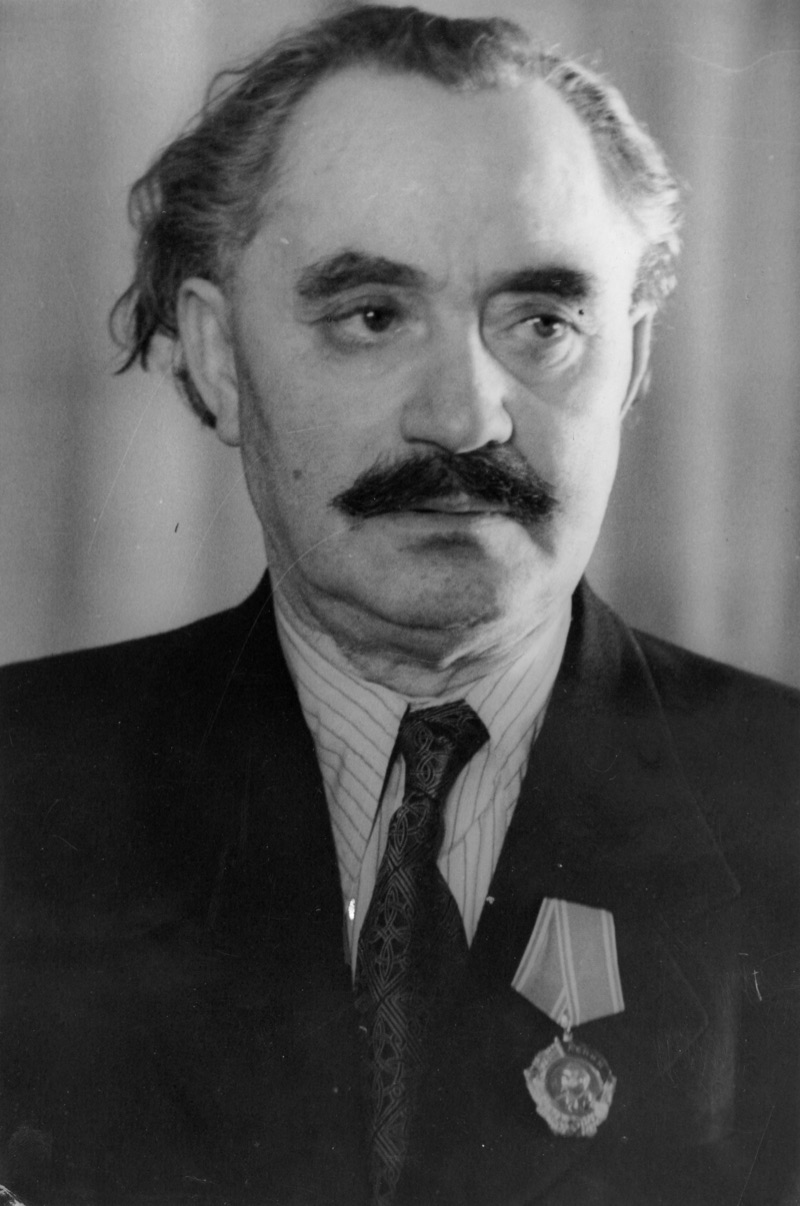
Georgi Dimitrov, official TASS portrait
Georgi Dimitrov · TASS portrait · public domain

The cross-examination · facing Göring

Dimitrov: Are you afraid of my questions, Mr. Prime Minister?
Göring: You will be afraid when we get you outside this court, you scoundrel!

Dimitrov: I am very satisfied with the Prime Minister's reply. The Prime Minister does not deny that the National Socialists' Storm Troopers had reason to be present in the Reichstag building before the fire began. He merely refuses to answer the question of whether the path led from the Reichstag building to the Reichstag president's palace, where Mr. Göring resided.

Presiding Judge Bünger: The witness is dismissed. Defendant Dimitrov, you are forbidden to speak.

— from the cross-examination of Hermann Göring, Prussian Minister-President and Reichstag President, by defendant Dimitrov, 4 November 1933. The exchange was reported around the world. Göring had taken the witness stand expecting to lecture the court on the Communist conspiracy that had supposedly burned the Reichstag; Dimitrov, defending himself without counsel and without notes, instead got Göring to scream a death threat in open court. The reporters present were the moment that turned international press coverage of the trial.

The closing statement · what Dimitrov said

I admit that my tone is hard and grim. The struggle of my life has always been hard and grim. My tone is frank and open. I am accustomed to call a spade a spade. I am no lawyer appearing before this Court in the mere way of his profession. I am defending myself, an accused Communist. I am defending my own political honour, my honour as a revolutionary. I am defending my Communist ideology, my ideals. I am defending the meaning and content of my whole life.

That is why every word I have spoken in this Court is, so to speak, my own flesh and blood. Every sentence is the expression of my deep indignation against the unjust accusation, against the placing of this anti-Communist crime — the burning of the Reichstag — to the account of the Communists.

— from the closing statement, 16 December 1933. Dimitrov was forbidden by the presiding judge to deliver the full closing he had prepared; the published version is reconstructed from the smuggled-out manuscript. Seven days later he was acquitted of all charges. The Nazi regime did not release him until February 1934, when he was exchanged to the Soviet Union as a Bulgarian-Soviet prisoner swap. Within eighteen months he was the General Secretary of the Comintern.

The defendant

Born 1882 in Kovachevtsi, then-Ottoman Bulgaria. Apprentice typesetter at age 12. Joined the Bulgarian Workers' Social Democratic Party at 20. Member of the Bulgarian Parliament 1913–1923. Forced into exile after the failed September 1923 anti-fascist uprising in Bulgaria. Lived in Vienna and Berlin through the late 1920s; was a leader of the Comintern's West European Bureau when Hitler took power in January 1933. Arrested in Berlin on 9 March 1933, eleven days after the Reichstag fire, on what Nazi prosecutors knew was a frame: the actual arsonist, Marinus van der Lubbe, had been caught at the scene and confessed to acting alone. Dimitrov was put on trial because the Nazi government wanted to use the fire to outlaw the German Communist Party (which they did within days) and to demonstrate an international Communist conspiracy (which they failed to do). After acquittal, Dimitrov became General Secretary of the Comintern (1935–1943) and delivered the popular-front speech that is S1.10. After the war, he served as Bulgarian Prime Minister 1946–49 until his death in Moscow.

Why this voice

Dimitrov was arrested by the Gestapo three weeks after Hitler took power. He was charged with conspiracy in the Reichstag fire — a charge that turned out to be a Nazi frame, with the actual arsonist a young Dutch communist acting alone. Dimitrov defended himself in open court for three months, in fluent German, against Hermann Göring on the witness stand. He was acquitted. The defense speeches — calm, scholarly, ferocious — became foundational courtroom-radicalism documents. Reading forward into S3: the prosecution from prison of a Black communist twenty-five years later (Henry Winston, S3.09) sits in the same lineage of state attempts to silence radical voices through the criminal courts. Reading forward into S2: Cabral (S2.09), Biko (S2.11), and Sankara (S2.12) all faced state-level frame-ups; only Dimitrov walked out alive.

Carry it

1 · If you were on trial for your political life, in a court whose verdict was already written, what would your opening sentence be? Write the first 200 words.

Unsaved

2 · Dimitrov made Göring scream a death threat in open court. What is the question that, asked of someone in power in your country today, would force them to drop the mask?

Unsaved

Source 10 · Speech · Session 1

The United Front Against Fascism · "The Offensive of Fascism and the Tasks of the Communist International"

Georgi Dimitrov — main report to the Seventh World Congress of the Communist International (Comintern), Moscow, 2 August 1935. Delivered eighteen months after Dimitrov's acquittal at the Reichstag Trial (S1.09) and fifteen months after his arrival in Moscow as a Soviet citizen. The speech pivoted the world communist movement from the "class against class" line of the Comintern's Third Period (1928–35) — which had treated social democrats as "social-fascists" — to a popular-front strategy of broad democratic alliance against fascism. Now in the public domain.

Country · Comintern · Moscow Form · Conference report Year · 1935 Pivot · "Third Period" → Popular Front
Georgi Dimitrov, official TASS portrait
Georgi Dimitrov · TASS portrait · public domain

The definition · what fascism is

Fascism in power is the open terrorist dictatorship of the most reactionary, most chauvinistic and most imperialist elements of finance capital.

The most reactionary variety of fascism is the German type of fascism. It has the effrontery to call itself National-Socialism, though it has nothing in common with socialism. German fascism is not only bourgeois nationalism, it is fiendish chauvinism. It is a government system of political gangsterism, a system of provocation and torture practised upon the working class and the revolutionary elements of the peasantry, the petty bourgeoisie and the intelligentsia.

— from Section I, "Fascism and the Working Class," opening of the substantive analysis. Dimitrov's definition of fascism — "the open terrorist dictatorship of the most reactionary, most chauvinistic and most imperialist elements of finance capital" — became the canonical Marxist definition of the phenomenon for the next century. The 1935 specification matters: fascism is named as the political form of finance capital under stress, not as a derangement of "the masses" or a recurrence of medievalism.

The pivot · what Dimitrov asked of the movement

The toiling masses in a number of capitalist countries are faced with the necessity of making a definite choice, and of making it today, not between proletarian dictatorship and bourgeois democracy, but between bourgeois democracy and fascism.

The interests of the class struggle of the proletariat against capitalism, of the struggle for the dictatorship of the proletariat, demand that there be a single political mass party of the proletariat in every country. But this is not a goal that can be reached overnight. To the question — does the proletariat need a united front of all the working class against fascism? — we answer: yes, it does. To the question — under what conditions must the unity of the working-class be achieved in this period? — we answer: it must be achieved in the spirit of the broadest mass actions, on the basis of the experience of the masses themselves.

— from Section II, "United Front of the Working Class against Fascism," and Section III, "The Anti-Fascist People's Front." The structural argument is that the choice in front of working-class movements in 1935 is no longer between bourgeois democracy and proletarian dictatorship, but between bourgeois democracy and fascism — and that the duty of the moment is to defend democracy by uniting with anyone willing to fight fascism, including liberals, social democrats, and what would now be called civil-society institutions.

The author · 1935, in office

Dimitrov was 53. He had been General Secretary of the Comintern for less than a year, having been elected to the post largely on the strength of his Reichstag-trial acquittal (S1.09). The audience was the Seventh World Congress: 510 delegates from 65 countries, meeting in Moscow over five weeks. The U.S. delegation was led by Earl Browder; among them was the young Black American organizer Harry Haywood (S3.03), then 36, returning from his Comintern training. Mao Zedong (S2.02) was not present but received the report by courier in Yan'an. Ho Chi Minh (S2.04) was also absent but reading. The popular-front line set at this congress is what authorized the CPUSA's eight-year alliance with the New Deal coalition, the Spanish Republican government's anti-fascist resistance, the French Front populaire of Léon Blum, and — through Browder and CPUSA national-front work — the conditions in which the U.S. Black radical canon of Session 03 was able to develop in mass-political form.

Why this voice

The founding document of the popular-front strategy that allowed the world communist movement — including the CPUSA — to enter mass alliances during the Great Depression and World War II. Without the popular-front pivot, the convergence and remixing that Session 02 traces, and the U.S. Black radical canon of Session 03, would have been structurally impossible. The CPUSA's mass labor work after 1935 (the CIO unionization drives), the cultural front of the late 1930s (which produced Aaron Copland's Lincoln Portrait, Earl Robinson's "Ballad for Americans," the Federal Theatre Project's Negro Theatre Unit, Robeson's [S3.07] mass concert career), and the alliances with civil-rights groups that produced Patterson's We Charge Genocide (S3.06) and the Freedomways network of Cooper Jackson (S3.08) — all rest on Dimitrov's 1935 reframe. Session 02 begins here.

Carry it

1 · Dimitrov defined fascism as "the open terrorist dictatorship of the most reactionary, most chauvinistic and most imperialist elements of finance capital." Apply that definition to the political formations in your country today. What does it surface? What does it mistake?

Unsaved

2 · What broad front does your situation now require? Name three groups you would not have included in your political coalition a year ago, and one you would have included that you no longer can. Why?

Unsaved

Session 02 · Movement

The Anti-Colonial Century

Lima · Yan'an · Hanoi · Algiers · Havana · Accra · Bissau · Dar es Salaam · Soweto · Ouagadougou · 1928–1987

Twelve voices, ten countries, six decades. Where Marxism left Europe and got remade by every liberation struggle that picked it up. Mariátegui in Lima translates Marx through the Andean indigenous condition, 1928. Mao codifies a peasant-revolutionary Marxism in a Yan'an cave, 1937. C.L.R. James turns to Haiti to find the workers' revolution Europe missed. Ho Chi Minh — who attended the Second Comintern Congress as a young delegate — writes poetry in a Kuomintang jail. Padmore makes the convergence and then makes the break. Fanon, in an Algerian war hospital, names the colonized as the new universal class. Cabral, in a Havana conference room in 1966, delivers the most rigorous theoretical contribution from African anti-colonial struggle. Rodney, four years before he is assassinated, traces world capitalism's role in African underdevelopment. Biko writes for the Black Consciousness Movement before South African police kill him at thirty. Sankara closes the century in Burkina Faso, killed at thirty-seven in a French-supported coup. The session is the middle of the journey — from European industrial misery to U.S. Black freedom struggle, the path runs through every nation that fought a colonial war between 1925 and 1990.

Source 01 · Essays · Session 2

Seven Interpretive Essays on Peruvian Reality · Siete ensayos de interpretación de la realidad peruana

José Carlos Mariátegui (José del Carmen Eliseo Mariátegui La Chira) — Peruvian journalist, organizer, and Marxist theorist, 1894–1930. Self-educated. Partially paralyzed from childhood; lost his right leg in 1924. Founded Amauta magazine in 1926 (named after the Quechua word for "wise teacher") and the Peruvian Socialist Party in 1928. Published Siete ensayos in Lima by Empresa Editora Amauta, 1928. Died of a chronic illness at 35. English translation by Marjory Urquidi, University of Texas Press, 1971. Now in long-circulation through marxists.org.

Country · Peru Form · Essays Year · 1928 / 1971 (EN) Method · Marx + the Andean indigenous condition
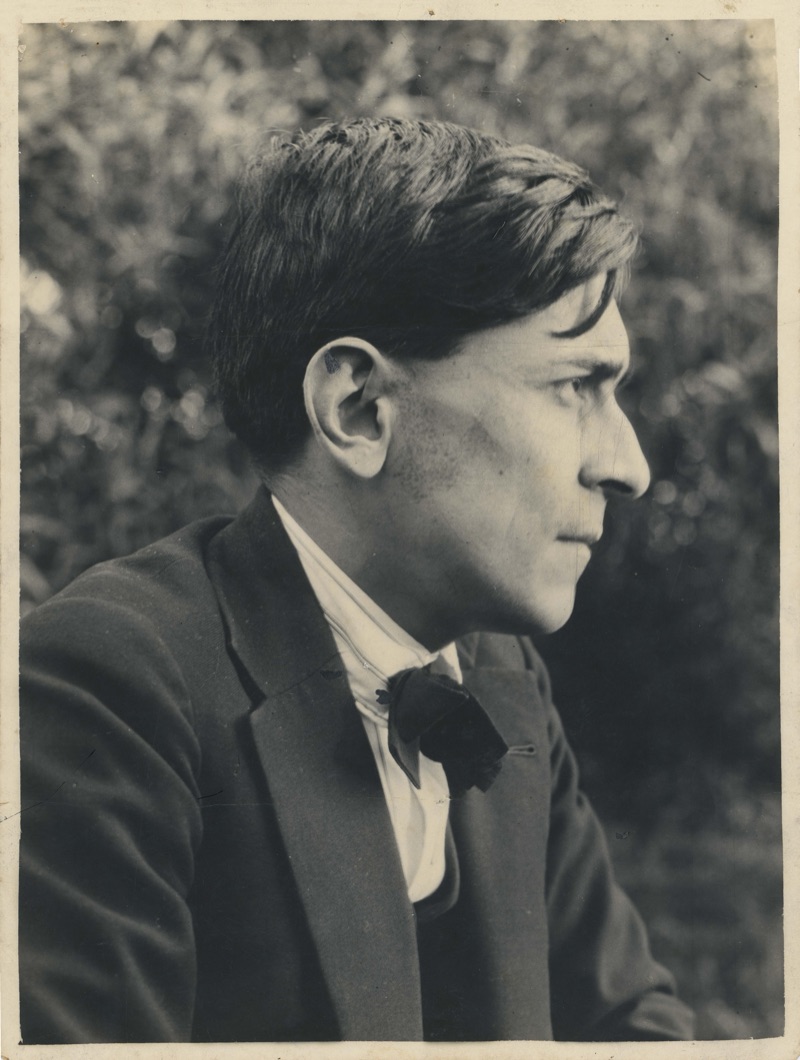
Jose Carlos Mariategui photographed in Lima, 1929
José Carlos Mariátegui · Lima · 1929 · public domain

The Indian question · the pre-capitalist commons

Any treatment of the problem of the Indian — written or verbal — that fails or refuses to recognize it as a socio-economic problem is but a sterile, theoretical exercise destined to be completely discredited. The Indian question, our principal problem, can be tackled only after one has thoroughly understood the structure of the Peruvian economy.

The assumption that the Indian problem is ethnic is sustained by the most outmoded repertoire of imperialist ideas. The concept of inferior races was useful to the white man's West for purposes of expansion and conquest. To expect that the Indian will be emancipated through a steady crossing of the aboriginal race with white immigrants is an anti-sociological naïveté.

— from "The Problem of the Indian," the second essay. Mariátegui's central methodological move: refuse the racialization of the Indigenous Peruvian peasantry by both the Peruvian liberal establishment and the European-Marxist orthodoxy of his day. The Indian's condition is not racial. It is the condition of dispossession from communal land. The solution therefore is not racial integration but agrarian revolution that returns the ayllu to its inhabitants.

The Inca commune · what came before capital

The communal life of the Indians, despite the Conquest, despite the colony, despite the republic, has continued in the high sierra in some of its essential characteristics. Communal property and the common cultivation of the land have continued to exist in the ayllu communities of Peru.

The communism of the Incas — which cannot be denied or disparaged because it developed under the autocratic regime of the Incas — is therefore a "logical Indian socialism." Once Spanish feudalism was rooted in the country, the existence of "Indian communism" was reduced and weakened, but it was not eliminated. Today, in the highlands, the ayllu survives as the primary social unit. Around it the Andean peasant economy organizes itself.

— from "The Land Problem," the third essay. Mariátegui's most controversial contribution to the Latin American Marxist canon. Where European Marxism in the 1920s read pre-capitalist communal property as a "feudal residue" to be cleared by capitalist development before socialism could begin, Mariátegui argued that the Andean ayllu was a living institution to be defended and built on. The argument anticipates by fifty years the indigenous-Marxist scholarship that would shape Bolivia's MAS, Ecuador's Pachakutik, and Mexico's Zapatistas.

The full text · Marxists Internet Archive

The Marjory Urquidi 1971 University of Texas Press translation, viewable via Internet Archive controlled digital lending. The Marxists Internet Archive hosts the complete Spanish text in HTML and partial English translations. A modern bilingual Spanish-English critical edition was issued by Monthly Review Press in 2011.

The theorist

Born 1894 in Moquegua, southern Peru, into modest circumstances. Bedridden by a serious illness at age eight; never received formal university education. Began publishing journalism at fourteen. Wrote for the Lima daily press through his teens and twenties. Spent 1919–1923 in Italy under a covert exile imposed by President Augusto Leguía's regime — became a witness to the rise of Italian fascism, the founding of the Italian Communist Party at Livorno (1921), and the Marxist debates that produced Antonio Gramsci. Returned to Lima in 1923 with his Italian wife Anna Chiappe and their son Sandro. Lost his right leg in 1924 to an old infection. Founded Amauta in 1926; published the Seven Essays in 1928; founded the Peruvian Socialist Party the same year. Died at 35 in April 1930 of complications from his lifelong illness, at the height of his powers.

Why this voice

The opening of the global movement. Mariátegui — a self-taught journalist with a partially paralyzed body and a five-year stay in fascist Italy behind him — sat down in Lima in 1928 and asked what Marx looked like applied to a country whose working class was indigenous, agrarian, and ten thousand years older than capitalism. His answer was a Marxism that took the Inca ayllu seriously as a basis for socialism, not as a feudal residue. He died at 35. His book is on every Latin American left reading list and almost no U.S. ones. Reading Mariátegui first in this session is reading the question that every later text has to answer in some form: what does Marx look like when he is read by a tradition that is older than capitalism?

Carry it

1 · What pre-capitalist commons in your community — kinship networks, mutual aid, neighborhood child-care, congregational support, indigenous land tenure — is the European left's vocabulary not equipped to see? Name three. Describe one in detail.

Unsaved

2 · Mariátegui refused the racialization of the Indigenous Peruvian peasantry. Whose condition in your country is being racialized when it is actually a condition of dispossession?

Unsaved

Source 02 · Theory · Session 2

On Contradiction · 矛盾论 · Máodùn lùn

Mao Zedong (毛泽东) — Chinese Communist organizer and theorist, 1893–1976. Delivered as lectures at the Anti-Japanese Military and Political University (Kàngdà) in Yan'an, August 1937 — two months after the 7 July Marco Polo Bridge Incident that began the full Japanese invasion of China. The companion lecture On Practice (实践论) was delivered in July 1937; the two essays are usually read together. Both revised by Mao for publication in his Selected Works, Foreign Languages Press, Beijing, 1952. Now in long-circulation translation in many languages.

Country · China · Yan'an Form · Lecture / theoretical essay Year · 1937 / pub. 1952 Subject · Dialectical materialism applied to Chinese conditions
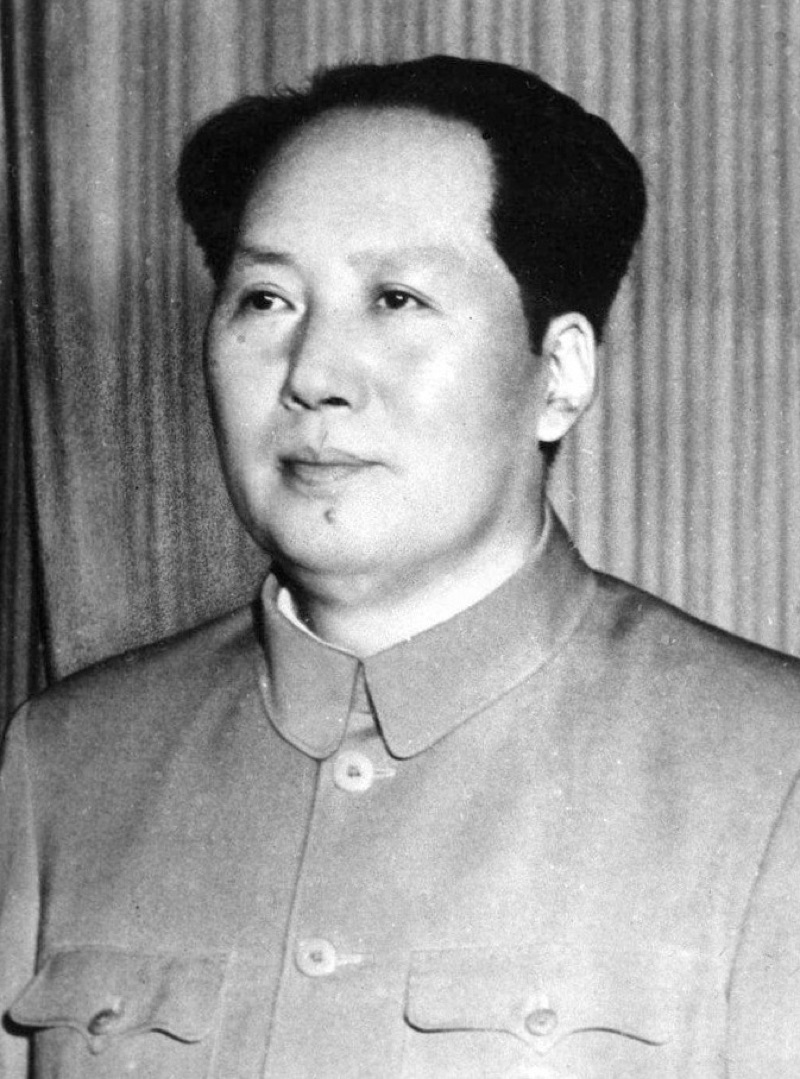
Mao Zedong, 1950 portrait
Mao Zedong · 1950 portrait · public domain

The principal contradiction · what to fight first

In any complex process there are a number of contradictions, of which one is necessarily the principal contradiction whose existence and development determine or influence the existence and development of the other contradictions.

When imperialism launches a war of aggression against such a country, all its various classes, except for some traitors, can temporarily unite in a national war against imperialism. At such a time, the contradiction between imperialism and the country concerned becomes the principal contradiction, while all the contradictions among the various classes within the country (including what was the principal contradiction, between the feudal system and the great masses of the people) are temporarily relegated to a secondary and subordinate position.

— from Section 4, "The Principal Contradiction and the Principal Aspect of a Contradiction." Mao's central theoretical move: in a society where multiple class antagonisms exist simultaneously, one of them is structurally principal at any given moment, and the others are subordinate. The judgment of which is principal is the central political question. In 1937, the principal contradiction in China was no longer between Chinese landlords and peasants — it was between the Chinese nation and Japanese imperialism. The shift authorized the Second United Front with the Kuomintang.

Universality and particularity · against doctrinal Marxism

The universality or absoluteness of contradiction has a twofold meaning. One is that contradiction exists in the process of development of all things, and the other is that in the process of development of each thing a movement of opposites exists from beginning to end.

When we begin to study any particular thing, we are confronted with two situations: First, the universality of the contradictions in things... Second, the particularity of the contradictions of things. The principle that we should not assume that the laws of capitalist society as analyzed by Marx in Capital apply mechanically to feudal society or to socialist society — this is a great revelation that liberates us from doctrinaire Marxism.

— from Sections 1 and 2, "The Two World Outlooks" and "The Universality of Contradiction." The argument that authorized every later non-European Marxism: the laws Marx identified in 19th-century industrial Britain do not transfer mechanically to 20th-century semi-colonial agrarian China, or to mid-20th-century Cuba (S2.06), or to a Guinea-Bissau village (S2.09). The principle of "particular contradictions in particular conditions" is the door through which the global anti-colonial movement walked.

The author · 1937, in Yan'an

Mao was 43. The Chinese Communist Party had completed the Long March two years earlier — the year-long retreat from Jiangxi to Shaanxi during which 80,000 Red Army troops had been reduced to about 8,000 survivors. The Yan'an base area in the loess hills of Shaanxi was the CCP's regrouping headquarters. The Anti-Japanese Military and Political University (Kàngdà) was the cave-and-tent training school where the CCP educated its officers, theorists, and journalists. Mao was lecturing daily — On Practice in July, On Contradiction in August — on the philosophical foundations of revolutionary practice. In the audience: Zhu De, Zhou Enlai, Liu Shaoqi, Lin Biao, and dozens of younger officers who would lead the People's Liberation Army to victory in 1949 and shape Chinese politics for the next half-century. The lectures were transcribed, mimeographed for cadres, and circulated through the Communist underground throughout occupied China.

Why this voice

Mao codifying — in a cave in northwest China, two months into a war that would eventually kill 20 million Chinese — a Marxism that took the peasantry, not the industrial working class, as the principal revolutionary force, and that took particular national conditions seriously rather than mechanically applying European templates. On Contradiction is the philosophical text the Chinese Revolution carried with it; it traveled into every later anti-colonial movement that read Mao — which was most of them, including the Vietnamese (S2.04), the Cubans (S2.06), the African anti-colonial movements (S2.08–12), the U.S. Black Panthers, the Naxalites, the Peruvian Sendero Luminoso, and the Indian Maoists. The text is short and dense. Reading it next to Lenin's State and Revolution (S1.06) is reading two writers solving the same problem in opposite hemispheres twenty years apart.

Carry it

1 · In your own situation — political, organizational, personal — what is the principal contradiction this year? What was the principal contradiction five years ago? What changed?

Unsaved

2 · Mao argues against applying Marx mechanically to non-European conditions. Where in your political work have you applied a foreign template to local conditions and gotten it wrong? What did the local conditions teach?

Unsaved

Source 03 · History · Session 2

The Black Jacobins: Toussaint L'Ouverture and the San Domingo Revolution

C.L.R. James (Cyril Lionel Robert James) — Trinidadian historian, Marxist theorist, novelist, cricket writer, 1901–1989. Published by Secker & Warburg, London, 1938. Written from London exile, where James had moved in 1932 and become active in the International African Service Bureau alongside George Padmore (S2.05) and where he had taught Kwame Nkrumah (S2.08) the rudiments of Marxist organizing. Revised edition with new appendix "From Toussaint L'Ouverture to Fidel Castro" published by Vintage, 1963.

Country · Trinidad / UK / USA Form · History · 380 pages Year · 1938 · revised 1963 Subject · The Haitian Revolution as world-historical event

The opening · the slaves of San Domingo

In 1789 the French West Indian colony of San Domingo supplied two-thirds of the overseas trade of France and was the greatest individual market for the European slave-trade. It was an integral part of the economic life of the age, the greatest colony in the world, the pride of France, and the envy of every other imperialist nation. The whole structure rested on the labour of half-a-million slaves.

In August 1791, after two years of the French Revolution and its repercussions in San Domingo, the slaves revolted. The struggle lasted for 12 years. The slaves defeated in turn the local whites and the soldiers of the French monarchy, a Spanish invasion, a British expedition of some 60,000 men, and a French expedition of similar size under Bonaparte's brother-in-law. The defeat of Bonaparte's expedition in 1803 resulted in the establishment of the Negro state of Haiti which has lasted to this day.

— from the Preface to the First Edition, 1938. James's central framing: the only successful slave revolution in modern history was a world-historical event on the scale of the French Revolution itself, and it has been almost entirely written out of European historical memory. The book is the recovery — the story told as it was, with the scale of forces correctly tallied.

The 1963 appendix · Toussaint to Castro

What took place in French San Domingo in 1792-1804 reappeared in Cuba in 1958. The slave revolt is now over a century and a half away. The Cuban Revolution, the latest in the West Indian sequence, comes nearer.

The people who made them, the problems and the attempts to solve them, are peculiarly West Indian, the product of a peculiar origin and a peculiar history. West Indians first became aware of themselves as a people in the Haitian Revolution. Whatever its ultimate fate, the Cuban Revolution marks the ultimate stage of a Caribbean quest for national identity.

— from the appendix "From Toussaint L'Ouverture to Fidel Castro," added to the 1963 Vintage edition. James reads Castro and the Cuban Revolution (S2.06) as the latest expression of the same Caribbean political tradition that began with Toussaint. The connection is structural: a Caribbean intellectual writing in the 1960s, looking at his own region's history, sees Toussaint and Castro as part of one ongoing argument.

The full text · Internet Archive

A scanned edition viewable via Internet Archive controlled digital lending. The book is in print and widely available; recent Penguin Modern Classics and Vintage editions are the standard student texts. James gave many recorded lectures and interviews on the book between the 1960s and 1980s; selections are at the C.L.R. James Institute and on YouTube.

The historian

Born 1901 in Tunapuna, Trinidad, into a Black middle-class family that prized education. Cricketer of the colonial elite circuit; teacher; literary editor of the Trinidad Gleaner. Moved to England in 1932 at the invitation of the Lancashire cricketer Learie Constantine. Became, almost on arrival, active in the International African Service Bureau (with George Padmore, S2.05) and in the Trotskyist movement. Taught Kwame Nkrumah (S2.08) elementary Marxism at the kitchen table of his London flat in 1934. Wrote The Black Jacobins 1936–38. Moved to the United States in 1938; lived there for 15 years; was deported in 1953 under McCarran Act provisions. Returned to Trinidad in 1958 to edit The Nation, the newspaper of the People's National Movement of Eric Williams; broke with Williams in 1960. Lived the rest of his life mostly in London. Wrote on Marxism, Caribbean politics, cricket (Beyond a Boundary, 1963), and Pan-Africanism. Died in Brixton, 1989. The Brixton flat where he died is now the C.L.R. James Library.

Why this voice

James told the story of the only successful slave revolution in modern history — Haiti, 1791–1804 — as a workers' revolution that the European left had missed. The book was written from London exile, shaped by James's Trotskyist commitments at the time, and aimed at the African-independence movements then forming. It became foundational to anti-colonial thought across Africa and the Caribbean. Nkrumah (S2.08) was James's student in the London years; Padmore (S2.05) was his comrade. James later distanced himself from Trotsky and from Stalin alike — the book remains the central text of the Black Marxist tradition's rereading of the Atlantic revolutionary cycle. Reading The Black Jacobins alongside Du Bois's Black Reconstruction (S3.02) — published three years earlier — is reading two Black scholars in adjacent decades doing the same kind of historical-materialist recovery on adjacent slave-revolution moments.

Carry it

1 · Which "side" of the world historical record contains the story you needed told? Name the event, the year, the historian who finally got it right.

Unsaved

2 · James updated his book in 1963 with a chapter that traced the same political current from Toussaint to Castro. What 21st-century event would your updated chapter add to the lineage you study?

Unsaved

Source 04 · Poetry · Session 2

Prison Diary · Nhật ký trong tù · 獄中日記

Ho Chi Minh (Hồ Chí Minh) — born Nguyễn Sinh Cung, 1890; later Nguyễn Tất Thành; later, in Comintern circles in Paris and Moscow, Nguyễn Ái Quốc; later Hồ Chí Minh ("the enlightened one"); 1890–1969. Wrote 134 short poems in classical Chinese while imprisoned by Kuomintang Chinese authorities at the Tianbao prison in Guangxi province, from late August 1942 through September 1943. The poems were composed on whatever paper came to hand: toilet paper, cigarette wrappers, the back of his own interrogation forms. The manuscript notebook survived the war by being passed hand-to-hand among Vietnamese exiles. First published in Vietnamese translation, Hanoi, 1960. English translation by Aileen Palmer, Foreign Languages Publishing House, Hanoi, 1962; revised English translation by Steve Bradbury, Tinfish Press, 2003.

Country · written in Kuomintang China by a Vietnamese revolutionary Form · Classical Chinese poetry, 134 poems Year · 1942–43 / pub. 1960 Note · Author attended the Second Comintern Congress, 1920 (delegate to S1.08)
Ho Chi Minh photographed in 1946
Ho Chi Minh · 1946 · public domain

"On Reading the Anthology of a Thousand Poets"

The ancients liked to sing of natural beauty:
Snow and flowers, moon and wind, mists, mountains and rivers.
Today we should make poems including iron and steel,
And the poet should also know how to lead an attack.

— Poem 124 of 134, working English after Aileen Palmer (1962). The poem is the most-anthologized of the collection. Ho's classical-Chinese training taught him the canonical Tang and Song masters; his political training reframed the inheritance. The poet, here, is also a strategist of the attack — and the line "the poet should also know how to lead an attack" became one of the founding aesthetic principles of Vietnamese socialist literature in the postwar era.

"Word-Play"

Take away the head from the character "prisoner,"
And the character "loyal" stands clearly on the page.
Take away the dot from the character "misery,"
And it changes to the character "happy."

Both kindness and severity are stored within a single fist:
Lift one — virtue; lift the other — punishment.
The man who would lead a thousand miles
Must learn to use both, like the artist using two brushes.

— Working English of two short poems, after Palmer / Bradbury. Ho's small, deliberate quietness is the formal signature of the collection: he writes Confucian-style epigrams that double as political instruction. The 134 poems are short, intimate, often comic, occasionally devastating. They are written in the script of a fourteen-hundred-year-old literary tradition by a man in a cage who would, two years after his release, declare an independent country.

The full text · Internet Archive

The 1962 Aileen Palmer translation, Foreign Languages Publishing House Hanoi edition, viewable via Internet Archive. Steve Bradbury's 2003 retranslation (Tinfish Press) is the more linguistically precise English version. The Vietnamese national archive holds the original notebook; reproductions are widely available.

The poet · the path that led to the cell

Born 1890 in Hoàng Trù village, central Vietnam, son of a Confucian scholar-official deposed by the French colonial administration. Worked as a cabin boy on a French steamer in 1911 — beginning of a thirty-year overseas exile. Lived in Marseille, Paris, London (where he was a pastry-chef apprentice under Auguste Escoffier at the Carlton Hotel), back to Paris (where in 1919 he submitted the "Demands of the Annamite People" to the Versailles Peace Conference and was ignored). Joined the French Socialist Party in 1919; left for the French Communist Party at its founding 1920 — at which point he attended the Second Comintern Congress in Moscow as a young Vietnamese delegate. Spent the 1920s and 1930s organizing across the world for Vietnamese independence: Moscow, Canton, Hong Kong, Bangkok, Yan'an. Imprisoned by the Kuomintang in 1942 on suspicion of being a spy (true, but for the wrong side — they thought French; he was working for the Vietnamese independence movement). Released 1943; returned to Vietnam; led the August 1945 declaration of an independent Democratic Republic of Vietnam, opening with the words of the U.S. Declaration of Independence: "All men are created equal."

Why this voice

Ho Chi Minh attended the 1920 Second Comintern Congress as a young Vietnamese delegate from Paris — one of the first Asian voices in the room when Lenin's "Theses on the National and Colonial Questions" (S1.08) was adopted. Twenty-two years later, he was in a Kuomintang jail in Guangxi, writing 134 poems in classical Chinese on toilet paper, on cigarette wrappers, on the back of his interrogation forms. The poems are small, precise, deeply Confucian-trained, and quietly political. The most internationally read Vietnamese literary work of the twentieth century. Reading the Prison Diary alongside Lenin's "Letter to American Workers" (S1.07) is reading two political prisoners writing in two languages across two decades, both addressed to readers in countries whose governments wanted them dead. Ho is the figure who carries the line of S1.08 directly into the practice of S2.

Carry it

1 · A revolutionary in jail writes 134 poems in his fourth language. What art does the situation you cannot leave demand of you? Write one short poem in the spirit of Ho's: small, formal, quietly political.

Unsaved

2 · "The poet should also know how to lead an attack." What attack does the writing in your life lead? What attack does it refuse?

Unsaved

Source 05 · Polemic · Session 2

Pan-Africanism or Communism? The Coming Struggle for Africa

George Padmore (born Malcolm Ivan Meredith Nurse) — Trinidadian Pan-Africanist and Marxist organizer, 1903–1959. Studied at Fisk and Howard. Joined the CPUSA in 1927; recruited to the Comintern in Moscow, 1929. Headed the Comintern's Negro Bureau (the International Trade Union Committee of Negro Workers) and edited The Negro Worker from Hamburg, 1931–34. Resigned from the Comintern in 1934 in protest of the Soviet line that subordinated African liberation to Moscow's diplomatic relations with Britain and France. Settled in London; co-organized the 1945 Fifth Pan-African Congress in Manchester with W.E.B. Du Bois (S3.02) and Kwame Nkrumah (S2.08). Moved to Accra in 1957 as Nkrumah's advisor on African affairs in the first independent government of Ghana. Died in London, 1959; buried in Christiansborg Castle, Accra. Pan-Africanism or Communism? published by Dennis Dobson, London, 1956.

Country · Trinidad / USSR / Germany / UK / Ghana Form · Political polemic Year · 1956 Position · The settling of accounts with Moscow

From the preface — why he wrote it

The central purpose of this book is to provide a clear understanding of the ideological forces — Pan-Africanism and Communism — competing for the loyalties and support of the rising African nationalist movements struggling to free themselves from white domination. The conflict between these two rival ideologies is bound to assume major proportions in the years immediately ahead, since both, although differing fundamentally on the historical role of nationalism, see Africa as the next great area of struggle.

Pan-Africanism rejects both white racialism and black chauvinism. It stands for racial co-existence on the basis of absolute equality and respect for human personality. While the African leaders of the Pan-African Congresses recognised the need of fraternal collaboration with the colonial liberation movements in Asia and other parts of the world, they nevertheless deemed it necessary to maintain their organisational independence in the same way as they had insisted upon their independence from the dictation of Moscow.

— George Padmore, preface to Pan-Africanism or Communism? The Coming Struggle for Africa, Dennis Dobson, London, 1956. The preface is the clearest single statement Padmore ever wrote of the position he had spent twenty years arriving at: that Africa needed to learn from Marxism without taking orders from Moscow.

From the chapter on his break with the Comintern, 1934

The decision of the Communist International, in pursuit of the new line of collective security, to liquidate the Negro Bureau and The Negro Worker, and thereby end the work of African and West Indian organisation which had been built up since 1928, was the immediate cause of my resignation. But the deeper cause was the realisation that the Soviet Union had ceased to be the centre of an anti-imperialist movement, and had become an ordinary great power pursuing the diplomatic interests of a state. From 1934 onwards, the colonial peoples of Africa and the West Indies could not look to Moscow for the kind of unconditional support against the European colonial powers that had been promised at the Sixth Comintern Congress of 1928. The Pan-African movement, which had been suspended during the years of close collaboration, had now to be revived.

— Padmore on the 1934 break, condensed from the chapter "How Russia Transformed Her Colonial Empire" in the same volume. The 1928 Sixth Comintern Congress had passed the "Black Belt" thesis affirming the right of national self-determination for African Americans and African colonized peoples; by 1934 Stalin's pursuit of an anti-fascist alliance with Britain and France required suppressing exactly that line. Padmore left.

The full text · out of print

First edition: Dennis Dobson, London, 1956, 463 pages, with foreword by Richard Wright. The book is currently out of print and not available as a public scan; held by major research libraries including the Schomburg Center, the British Library, and the University of Ghana Padmore Library. The 1972 Doubleday Anchor reprint can sometimes be found through used-book channels. The Marxists Internet Archive maintains a Padmore section with selected essays from The Negro Worker, 1929–34. Find a library copy via WorldCat →

The organizer · the bridge from Moscow to Accra

Born Malcolm Nurse in Tacarigua, Trinidad, 1903, son of a teacher and amateur naturalist. Migrated to the United States in 1924, studied at Fisk and at Howard Law. Joined the Communist Party USA in 1927 under the name "George Padmore" (the surname taken from a friend's). The Comintern recruited him in 1929 and sent him to Moscow, where by 1931 he was the most senior person of African descent in the apparatus, heading the International Trade Union Committee of Negro Workers and editing the multilingual organ The Negro Worker from Hamburg. He coordinated black labor and anti-colonial work across the Atlantic — West Africa, the Caribbean, the U.S. South, the Liverpool and Cardiff seamen. He resigned in 1934. He moved to London. He spent the next eleven years as a freelance Pan-Africanist publisher, working with C.L.R. James (S2.03) and Jomo Kenyatta in the International African Service Bureau. In October 1945 he and Du Bois (S3.02) and Nkrumah (S2.08) co-organized the Fifth Pan-African Congress in Manchester — the meeting that turned Pan-Africanism from a diaspora intellectual project into a political program for African independence. When Nkrumah won the Gold Coast elections of 1956, Padmore moved to Accra as his advisor on African affairs. He died in London in 1959 of liver disease, age 56. His ashes were flown to Accra and interred in the wall of Christiansborg Castle.

Why this voice

Padmore is the figure in this volume who made the convergence and then made the break — and the book is the account of both halves. He went deeper inside the Comintern than any other person of African descent of his generation. He left because the Soviet state put its diplomatic accounts above African self-determination. And then, having left, he did not abandon Marxism: he carried the analysis into a Pan-Africanism that he and his collaborators argued was the only formation in which African peoples could be both Marxist and free. Reading him connects S1.08 (Lenin's "Theses on the National and Colonial Questions") forward through his own 1934 break, through the 1945 Manchester Congress, through Nkrumah (S2.08) in Ghana, into the broader anti-colonial century. Padmore is also why Pan-Africanism or Communism? is in this volume of the Companion productline at all: a Marxist genealogy of African and Caribbean radicalism that does not include the Comintern's Negro Bureau and its dissolution is incomplete.

Carry it

1 · Padmore left a movement that had given him status, language, salary, and global infrastructure — because the movement asked him to subordinate the people he was accountable to. Where in your political life are the limits of your alliance? What would force you to break, and what would you carry with you?

Unsaved

2 · After the break, Padmore did not stop being a Marxist. He carried the analysis into a different formation. What ideas would you take with you out of a movement you had to leave? What would the next room you build with them look like?

Unsaved

Source 06 · Essay · Session 2

Notes for the Study of the Ideology of the Cuban Revolution · Notas para el estudio de la ideología de la Revolución cubana

Ernesto "Che" Guevara — Argentine-Cuban revolutionary and physician, 1928–1967. Published in Verde Olivo, the magazine of the Cuban Revolutionary Armed Forces, 8 October 1960. The Centro de Estudios Che Guevara in Havana maintains the canonical Spanish edition; the Marxists Internet Archive holds the standard English translation. Che was at this point the National Bank president of revolutionary Cuba and one of its most public theorists; the essay was addressed to a young army readership trying to make sense of what they had just done.

Country · Argentina / Cuba Form · Essay Year · 1960 Subject · The theoretical originality of the Cuban Revolution
Che Guevara photographed by Alberto Korda in 1960
Che Guevara · 1960 · Alberto Korda · public domain

The opening — the revolution as event before theory

This is a unique revolution which some people maintain contradicts one of the most orthodox premises of the revolutionary movement, expressed by Lenin: "Without a revolutionary theory there is no revolutionary movement." It would be suitable to say that revolutionary theory, as the expression of a social truth, surpasses any declaration of it; that is to say, even if the theory is not known, the revolution can succeed if historical reality is interpreted correctly and if the forces involved in it are utilized correctly.

Whoever observes it can see that in the Cuban Revolution there is a new movement, perceived sometimes inside and outside the country: that of a Marxist revolution, with the peculiarity, the new variation, that it has not been carried out by an old vanguard, but by armed groups composed of revolutionaries who are creating their own theoretical conscience as they go.

— Che Guevara, opening passage of "Notes for the Study of the Ideology of the Cuban Revolution," Verde Olivo, 8 October 1960. The argument is heretical against orthodox Leninist sequencing — theory then party then revolution — and Che is making it deliberately, in the army magazine, addressed to fighters whose own act of revolution is the evidence.

From the conclusion — what the rural guerrilla taught

The first lesson of the Cuban Revolution is that the popular forces can win a war against an army; the second, that it is not always necessary to wait for all conditions favorable to revolution to be present, since the insurrection itself can create them; the third, that in the underdeveloped countries of the Americas the countryside is the basic arena for armed struggle.

From these three principles flow the strategic posture of the Cuban Revolution. They are not predictions of what will happen in every country. They are the lessons drawn from one revolution by the people who made it. Other revolutions — in Africa, in Asia, in our own America — will have their own forms, their own rhythms, their own theoretical contributions to the world movement of the working peoples. But the question of whether to wait for the textbook conditions, or to begin, is settled in the hills of Oriente.

— Che on the three lessons, working English from the Centro de Estudios edition. The three lessons are reformulated and extended in Che's 1961 book Guerrilla Warfare and again in the 1967 "Message to the Tricontinental." The 1960 essay is the earliest mature statement.

Bridge to a longer reading · Internet Archive

The standard English collection: Che Guevara Reader, edited by David Deutschmann (Ocean Press, expanded edition 2003). Includes the 1960 ideology essay, key speeches at the UN and OAS, the 1965 "Socialism and Man in Cuba," and the 1967 "Message to the Tricontinental" (his final political testament before Bolivia). Available via Internet Archive controlled digital lending.

The fighter · the path from Buenos Aires to Sierra Maestra

Born Ernesto Guevara de la Serna, 1928, in Rosario, Argentina, eldest son of a left-leaning middle-class family. Asthmatic from age two; the asthma shaped his lifelong physical discipline. Trained as a physician at the University of Buenos Aires, finishing 1953. Two motorcycle journeys across Latin America between 1951 and 1954 produced what would later be published as The Motorcycle Diaries: the radicalizing exposure to Andean poverty, leper colonies, the United Fruit company towns. In Guatemala in 1954 he watched the CIA-backed overthrow of Jacobo Árbenz; the lesson was decisive. In Mexico City the next year he met the exiled Cuban brothers Fidel and Raúl Castro, joined the 26th of July Movement, and sailed with them on the Granma in November 1956 as troop physician. He was promoted to Comandante in mid-1957, the first non-Cuban to hold the rank. Took the strategically decisive city of Santa Clara in December 1958. Held senior positions in revolutionary Cuba — head of La Cabaña, president of the National Bank, Minister of Industries — through 1965, when he resigned to fight elsewhere. Killed by Bolivian Army Rangers under CIA direction in La Higuera, Bolivia, 9 October 1967, age 39. His diary survived, recovered by the CIA and later returned to Cuba.

Why this voice

Che on the originality of a non-European, non-industrial revolution. The 1960 essay is short, polemical, and influential out of all proportion to its length, because it argues — against the orthodox Leninist sequencing in S1.06 (State and Revolution) and S1.07 (Lenin's letter on industrial-worker preconditions) — that revolution can begin where it must, with the forces actually present. Reading it next to Mao on contradiction (S2.02) and Cabral on the weapon of theory (S2.09) is reading three Marxists outside the European industrial core working out what their own situations require. Reading it next to Padmore (S2.05) is reading a different post-Comintern strategy: not a break with Marxism, but a creative extension of it through the conditions of the Americas. Cross-reference: Vol 02 of the Companion productline (Reading the Removed) treats Che's poetry; this volume treats the political theorist.

Carry it

1 · "It is not always necessary to wait for all conditions favorable to revolution to be present, since the insurrection itself can create them." What political action in your context is being deferred until the conditions are right? Who is doing the deferring? What would beginning look like?

Unsaved

2 · Che was a doctor who carried a rifle. The combination is not incidental — he treated the wounded on both sides. What two roles in your life feel incompatible, and what would carrying both look like in practice?

Unsaved

Source 07 · Essays · Session 2

The Wretched of the Earth · Les Damnés de la Terre

Frantz Fanon — Martinican psychiatrist, organizer, and theorist, 1925–1961. Trained in psychiatry at Lyon. Worked at Blida-Joinville Psychiatric Hospital in colonial Algeria from 1953; resigned 1956 in a now-famous letter to the resident-minister (Robert Lacoste) declaring the impossibility of curing patients while their society was sick. Joined the Algerian National Liberation Front (FLN) and edited its Tunis-based paper El Moudjahid. Diagnosed with leukemia in late 1960; dictated Les Damnés de la Terre to his wife Josie Fanon over the spring and summer of 1961. Preface by Jean-Paul Sartre. Published by François Maspero, Paris, 17 November 1961. Fanon died at the National Institutes of Health in Bethesda, Maryland (where he was receiving leukemia treatment), six weeks later, on 6 December 1961, age 36. Buried in FLN territory in eastern Algeria. Standard English translation: Constance Farrington (Grove Press, 1963); revised translation by Richard Philcox, 2004.

Country · Martinique / Algeria / France / Tunisia Form · Essays Year · 1961 Conditions · Written while dying
Frantz Fanon, dust jacket photo from Black Skin White Masks
Frantz Fanon · Black Skin White Masks dust jacket photo

From "Concerning Violence" — the opening

National liberation, national renaissance, the restoration of nationhood to the people, commonwealth: whatever may be the headings used or the new formulas introduced, decolonization is always a violent phenomenon. At whatever level we study it — relationships between individuals, new names for sports clubs, the human admixture at cocktail parties, in the police, on the boards of directors of national or private banks — decolonization is quite simply the replacing of a certain "species" of men by another "species" of men.

Without any period of transition, there is a total, complete, and absolute substitution. It is true that we could equally well stress the rise of a new nation, the setting up of a new state, its diplomatic relations, and its economic and political trends. But we have precisely chosen to speak of that kind of tabula rasa which characterizes at the outset all decolonization.

— Frantz Fanon, opening of "Concerning Violence," Chapter 1 of Les Damnés de la Terre. English: Constance Farrington, Grove Press, 1963. The chapter is the most-quoted, most-misread section of the book; Sartre's preface amplified the violence reading at the cost of the rest of the volume's clinical and political analysis.

From "On National Culture" — the warning to the new ruling class

The national bourgeoisie of underdeveloped countries is not engaged in production, nor in invention, nor in building, nor in labor. It is completely canalized into activities of the intermediary type. Its innermost vocation seems to be to keep in the running and to be part of the racket. The psychology of the national bourgeoisie is that of the businessman, not that of a captain of industry; and it is only too true that the greed of the settlers and the system of embargoes set up by colonialism has hardly left them any other choice.

A bourgeoisie similar to that which developed in Europe is able to elaborate an ideology and at the same time strengthen its own power. The bourgeoisie of underdeveloped countries, on the other hand, having nothing to invest, is incapable of seizing the opportunity offered to it. Two attitudes are possible: either an alliance with the imperialism that they were supposedly leaving — and the consequent strangulation of the national project — or the development of the working class.

— Fanon, from "The Pitfalls of National Consciousness," Chapter 3. The chapter is the prophecy of post-colonial Africa that came true: the national bourgeoisie taking the place of the colonizer rather than transforming the system. Cabral (S2.09), Sankara (S2.12), and Rodney (S2.10) all read this chapter as the diagnostic frame for what was happening in their own countries.

The full text · Internet Archive

The Constance Farrington translation, Grove Press 1963 — the edition that reached the Black Panthers, the U.S. New Left, and the entire English-language anti-colonial reading public for forty years. Richard Philcox's 2004 retranslation (Grove Press) corrects significant translation errors in the Farrington edition; both are standard. The original French Les Damnés de la Terre remains in print at Éditions La Découverte.

The psychiatrist · the path through the colonial clinic

Born 1925 in Fort-de-France, Martinique, into a middle-class Creole family of mixed African, Indian, and European descent. At the lycée he was taught by Aimé Césaire, the founder of Négritude, who shaped his early political consciousness. Volunteered for the Free French Forces in 1943; fought in North Africa and France; was wounded at the Battle of Alsace in 1944 and decorated with the Croix de Guerre. The experience of fighting as a colonized soldier for an empire that did not recognize his humanity shaped Black Skin, White Masks (1952), his medical thesis turned into his first book. Trained in psychiatry at Lyon under François Tosquelles, founder of institutional psychotherapy. Took up his post at Blida-Joinville Psychiatric Hospital, Algeria, 1953. Treated Algerian patients on one ward and French police torturers (suffering from what we would now call PTSD from the work of torturing Algerians) on another. Resigned 1956. Joined the FLN. Worked as Algerian Provisional Government's Ambassador to Ghana 1960. Diagnosed with leukemia. Wrote Les Damnés in the months he had left.

Why this voice

Fanon names the colonized — and the wretched of the global system — as the new universal class. The book is the most influential single text of the twentieth-century anti-colonial movement. It reaches Cabral (S2.09), Biko (S2.11), Sankara (S2.12), Davis (S3.10), Malcolm X, the Black Panthers, the New Communist movement, and onward. He wrote it dictating from his hospital bed in the last spring and summer of his life. Reading it in this volume of the Companion productline, between Padmore (S2.05) and Cabral (S2.09), is reading the through-line of a Marxism that does not begin in European factories. Cross-reference: Vol 02 (Reading the Removed) treats Fanon's prose; this entry pulls the strand into the theoretical lineage of the European → global → U.S. arc. The chapter "The Pitfalls of National Consciousness" is, more than half a century later, the diagnostic frame anyone trying to understand what happened to the post-1960 African liberation movements eventually arrives at.

Carry it

1 · Fanon was a doctor who treated patients on both sides of a torture system: Algerian survivors and French torturers. The cure required dismantling the system that produced both. What system in your life has you serving on more than one side at once? What does the work of the cure look like?

Unsaved

2 · "The Pitfalls of National Consciousness" is Fanon's warning that political independence without economic transformation produces a new ruling class wearing the costume of liberation. Where in your community or country do you see this warning becoming real? What would the alternative look like?

Unsaved

Source 08 · Political Economy · Session 2

Neo-Colonialism, the Last Stage of Imperialism

Kwame Nkrumah (born Francis Nwia Kofi Ngonloma) — first Prime Minister (1957–60) and first President (1960–66) of independent Ghana, 1909–1972. Studied at Lincoln University and the University of Pennsylvania, 1935–45; wrote his master's thesis on logical positivism while organizing the African Students' Association of America. Met C.L.R. James (S2.03) and George Padmore (S2.05) in London after 1945; co-organized the Fifth Pan-African Congress in Manchester, October 1945. Returned to the Gold Coast 1947; founded the Convention People's Party 1949; led the independence movement; became head of state of independent Ghana in March 1957 — the first sub-Saharan African colony to win independence in the twentieth century. Overthrown in a CIA-supported military coup, 24 February 1966, while traveling to Hanoi to attempt to mediate the Vietnam War. Lived the rest of his life in Conakry, Guinea, as co-president-in-exile of Guinea by Sékou Touré's invitation. Died in Bucharest, 27 April 1972, of cancer. Neo-Colonialism, the Last Stage of Imperialism published by Thomas Nelson & Sons, London, 1965.

Country · Ghana Form · Political economy Year · 1965 Note · Author overthrown 1966 in CIA-supported coup
Kwame Nkrumah at the White House 1961
Kwame Nkrumah · 1961 · JFK Library · public domain

From the introduction — naming the system

The essence of neo-colonialism is that the State which is subject to it is, in theory, independent and has all the outward trappings of international sovereignty. In reality its economic system and thus its political policy is directed from outside.

The methods and form of this direction can take various shapes. For example, in an extreme case the troops of the imperial power may garrison the territory of the neo-colonial State and control the government of it. More often, however, neo-colonialist control is exercised through economic or monetary means. The neo-colonial State may be obliged to take the manufactured products of the imperialist power to the exclusion of competing products from elsewhere. Control over government policy in the neo-colonial State may be secured by payments towards the cost of running the State, by the provision of civil servants in positions where they can dictate policy, and by monetary control over foreign exchange through the imposition of a banking system controlled by the imperial power.

— Kwame Nkrumah, introduction to Neo-Colonialism, the Last Stage of Imperialism, Thomas Nelson & Sons, London, 1965. The book extends Lenin's Imperialism, the Highest Stage of Capitalism (S1.05) into the post-1945 world: formal political independence had not ended colonial extraction; it had only changed the mechanism.

From the conclusion — the response to the book

The result of neo-colonialism is that foreign capital is used for the exploitation rather than for the development of the less developed parts of the world. Investment under neo-colonialism increases rather than decreases the gap between the rich and the poor countries of the world.

The struggle against neo-colonialism is not aimed at excluding the capital of the developed world from operating in less developed countries. It is aimed at preventing the financial power of the developed countries being used in such a way as to impoverish the less developed.

— Nkrumah, conclusion. The book provoked a formal U.S. State Department protest and the cancellation of a $35 million aid package to Ghana — confirming, in effect, the book's thesis. The CIA-supported coup followed three months after publication.

The full text · Internet Archive

First edition, Thomas Nelson & Sons, London, 1965. The appendices to the original edition include detailed tables of foreign ownership of African mineral, banking, and shipping enterprises — the empirical evidence for the book's argument. The Marxists Internet Archive maintains the full text alongside Nkrumah's later books from exile (Class Struggle in Africa, 1970; Revolutionary Path, 1973).

The president · the path from Nkroful to Conakry

Born in Nkroful, in the Western Region of the Gold Coast (present-day Ghana), 1909, son of a goldsmith. Trained at Achimota College, then taught for several years before sailing for the United States in 1935. Studied at Lincoln University, Pennsylvania (B.A., theology and economics), and the University of Pennsylvania (M.S., education; M.A., philosophy). Lived for ten years in the United States — the formative period — and recalled the experience as one of being radicalized by Jim Crow as much as by the academic curriculum. Moved to London 1945 to study law and economics at the LSE; instead, was drawn into the Pan-African circles around Padmore (S2.05) and James (S2.03). Co-organized the Fifth Pan-African Congress in Manchester, October 1945, at which Padmore and Du Bois (S3.02) were the senior figures and Nkrumah was the rising organizer. Returned to the Gold Coast 1947 to organize for independence. Won the 1951 election from a colonial prison cell; led Ghana to independence 6 March 1957. Became head of state of the first independent sub-Saharan African nation. Wrote Neo-Colonialism in 1965. Was overthrown 24 February 1966 in a CIA-supported coup. Lived in Conakry as Sékou Touré's guest and co-president-in-exile until his death in 1972.

Why this voice

Nkrumah is the figure in this volume who tested the ideas of S1 and S2 in the practice of state-building. He was a student of Padmore (S2.05) and James (S2.03); he carried the theoretical work of Lenin's Imperialism (S1.05) into a book that named the post-1945 system as neo-colonialism; he then ran a country that the system was designed to recolonize. The book is the diagnosis of why his coup was inevitable and why every other African and Caribbean leader who tried to break out of the dollar-pound-franc orbit faced similar pressure. The Cabral (S2.09), Rodney (S2.10), and Sankara (S2.12) entries that follow are all extending the analysis Nkrumah formalized here. The CIA's involvement in the 1966 coup was confirmed by John Stockwell's 1978 memoir In Search of Enemies and by subsequently declassified documents. The Companion productline reads Nkrumah as the convergence and Cabral, Rodney, Biko, Sankara as the next generation extending the argument under conditions Nkrumah could not finish solving.

Carry it

1 · Trace one debt your country owes — sovereign debt to the IMF, World Bank, a foreign multinational, a development bank. Whose extraction is it? Whose accumulation does it fund? Whose lives does the repayment compress?

Unsaved

2 · The book argues that formal independence is not real independence if economic policy is set abroad. Where in your community or workplace is the formal authority in one set of hands and the operational power in another? What would it look like to make those match?

Unsaved

Source 09 · Speech · Session 2

The Weapon of Theory

Amílcar Cabral — agronomist, theorist, and leader of the African Party for the Independence of Guinea and Cape Verde (PAIGC), 1924–1973. Born in Bafatá, Portuguese Guinea (present-day Guinea-Bissau), to Cape Verdean parents. Trained at the Higher Institute of Agronomy in Lisbon (1945–50). Returned to Guinea 1952 to conduct an agricultural census of the entire territory — fieldwork that became the demographic and class-mapping foundation of the PAIGC's eventual armed struggle. Founded PAIGC in 1956. Began armed struggle against Portuguese colonialism in 1963. By the early 1970s the PAIGC controlled two-thirds of the country. Address "The Weapon of Theory" delivered to the First Tricontinental Conference (OSPAAAL), Havana, January 1966. Cabral was assassinated by Portuguese intelligence operatives in collaboration with a small group of party defectors, 20 January 1973, in Conakry, Guinea, eight months before Guinea-Bissau declared independence and twenty months before the carnation revolution toppled the Portuguese regime in Lisbon.

Country · Guinea-Bissau / Cape Verde Form · Conference address Year · 1966 Forum · Tricontinental Conference, Havana
Amilcar Cabral photographed in 1972
Amílcar Cabral · 1972 · public domain

From the speech — what theory is for

Always bear in mind that the people are not fighting for ideas, for the things in anyone's head. They are fighting to win material benefits, to live better and in peace, to see their lives go forward, to guarantee the future of their children.

Hide nothing from the masses of our people. Tell no lies. Expose lies whenever they are told. Mask no difficulties, mistakes, failures. Claim no easy victories.

— Amílcar Cabral, "The Weapon of Theory," address to the First Tricontinental Conference, Havana, January 1966. The two passages above are the most-quoted lines of Cabral's career; the second is the line Maurice Bishop's New Jewel Movement and the African National Congress's MK both adopted as part of their internal political education.

From the speech — class suicide and the petty bourgeoisie

We see therefore that if national liberation is essentially a political problem, the conditions for its development give it certain characteristics which belong to the sphere of morals. The leadership of the petty bourgeoisie — that part of the colonial population which by its position in the colonial economy can have access to revolutionary culture — must be capable of committing suicide as a class, in order to be reborn as revolutionary workers, completely identified with the deepest aspirations of the people to which they belong.

This alternative — to betray the revolution, or to commit suicide as a class — constitutes the dilemma of the petty bourgeoisie in the general framework of the national liberation struggle. The positive solution in favor of the revolution depends on what Fidel Castro recently correctly called the development of revolutionary consciousness.

— Cabral on what he called "class suicide" — the necessary self-transformation of the educated colonial intermediary class. The argument is structurally adjacent to but distinct from Fanon's "Pitfalls of National Consciousness" (S2.07): both diagnose the same risk; Cabral specifies the path through it.

Cabral's collected work · Internet Archive

Return to the Source: Selected Speeches of Amílcar Cabral, edited by Africa Information Service, Monthly Review Press, 1973. Includes "The Weapon of Theory," "National Liberation and Culture" (delivered at Syracuse University, February 1970), and the speeches Cabral gave at the United Nations and at the African Liberation Day rallies organized by U.S.-based Pan-African groups in 1972. The Marxists Internet Archive maintains a Cabral section with the full set in English translation.

The agronomist · the path from soil to liberation

Born 1924 in Bafatá to Cape Verdean parents — the son of a teacher and a poet. Educated in São Vicente, Cape Verde, then sent to Lisbon on a scholarship to study agronomy at the Instituto Superior de Agronomia, where he met Mário Pinto de Andrade and the small group of African students who would later lead the liberation movements of Portuguese-speaking Africa. Returned to Guinea 1952 with the assignment of conducting the colony's first agricultural census — a job that took him into nearly every village and produced an unparalleled empirical knowledge of the country's ethnic, economic, and social composition. The data became the foundation of the PAIGC's mass-organizing strategy. Founded PAIGC 1956; began armed struggle 1963; by 1972 the PAIGC controlled two-thirds of Guinea and had effectively established a parallel state with schools, health clinics, and a judiciary. The Portuguese tried for a decade to assassinate him; on 20 January 1973, in Conakry, they succeeded — using a small group of PAIGC defectors as the operational team. Eight months later Guinea-Bissau declared independence; twenty months later the Portuguese empire fell. Cabral never saw either. He was 48.

Why this voice

The most rigorous theoretical contribution from African anti-colonial struggle. Cabral — trained as an agronomist, leading an armed liberation war against Portuguese colonialism — used the Tricontinental stage in Havana to argue (1) that revolutionary theory must be rooted in the material conditions of the people, not imported wholesale from Europe; (2) that the petty-bourgeois colonial intelligentsia faces a dilemma — betray the revolution or "commit class suicide"; (3) that the national liberation struggle is at base a cultural struggle for the right of a people to be the maker of its own history. Reading Cabral next to Mao on contradiction (S2.02), Che on the Cuban Revolution (S2.06), and Fanon on "Pitfalls of National Consciousness" (S2.07) is reading four theorists working out what a non-European Marxism actually requires. Reading him next to Padmore (S2.05) and Nkrumah (S2.08) is reading three generations of Pan-Africanism, from the convergence with the Comintern, through the post-Bandung non-aligned moment, into the Tricontinental.

Carry it

1 · "Tell no lies. Claim no easy victories." Apply this to one campaign or project you are part of. What lies are being told? What easy victories are being claimed? What would Cabral's discipline change about your reporting?

Unsaved

2 · "Class suicide" is Cabral's name for the conscious self-transformation of an educated intermediary class that chooses to identify with the people's struggle rather than with its own privileged position. Where in your life are you the petty bourgeois Cabral is addressing? What would the work look like?

Unsaved

Source 10 · History · Session 2

How Europe Underdeveloped Africa

Walter Rodney — Guyanese historian, organizer, and theorist, 1942–1980. Doctorate in African History from SOAS, University of London, 1966 (dissertation: A History of the Upper Guinea Coast, 1545–1800). Taught at the University of the West Indies, Mona, Jamaica, 1968 — barred from re-entering Jamaica that October by the Hugh Shearer government, triggering the Rodney Riots. Moved to the University of Dar es Salaam, Tanzania, 1969–74, where he wrote How Europe Underdeveloped Africa. Returned to Guyana 1974; co-founded the Working People's Alliance 1974; was barred by the Forbes Burnham government from taking up the chair of history at the University of Guyana. Killed by a bomb in Georgetown, 13 June 1980, age 38. A 2016 Guyanese Commission of Inquiry concluded that the bomb had been delivered by an agent of the Guyanese army acting on behalf of the Burnham government. Book first published by Bogle-L'Ouverture (London) and Tanzania Publishing House (Dar es Salaam), 1972.

Country · Guyana / Tanzania / Jamaica Form · World-system history Year · 1972 Subject · The empirical case for Lenin's Imperialism
Walter Rodney in Tanzania, circa 1972
Walter Rodney · Tanzania c.1972 · public domain

From the introduction — what "underdevelopment" means

The question as to who and what is responsible for African underdevelopment can be answered at two levels. First, the answer is that the operation of the imperialist system bears major responsibility for African economic retardation by draining African wealth and by making it impossible to develop more rapidly the resources of the continent. Secondly, one has to deal with those who manipulated the system and those who are either agents or unwitting accomplices of the said system.

The capitalists of Western Europe were the ones who actively extended their exploitation from inside Europe to cover the whole of Africa. Imperialism is a phase of capitalist development in which Western European capitalist countries, the U.S., and Japan established political, economic, military, and cultural hegemony over other parts of the world which were initially at a lower level and therefore could not resist effectively. Imperialism is essentially an economic phenomenon, and it does not necessarily lead to direct political control or "colonialism."

— Walter Rodney, introduction to How Europe Underdeveloped Africa, Bogle-L'Ouverture / Tanzania Publishing House, 1972. Rodney is operationalizing Lenin's Imperialism (S1.05) and Nkrumah's Neo-Colonialism (S2.08) with five hundred years of documented African economic history. The book ran to 285 pages of text and 60 pages of footnotes in the original edition.

From the chapter on the slave trade — the accounting

The decisiveness of the short period of colonialism and its negative consequences for Africa spring mainly from the fact that Africa lost power. Power is the ultimate determinant in human society, being basic to the relations within any group and between groups. It implies the ability to defend one's interests and if necessary to impose one's will by any means available.

When one society finds itself forced to relinquish power entirely to another society, that in itself is a form of underdevelopment. During the centuries of pre-colonial trade, some control over social, political, and economic life was retained in Africa, in spite of the disadvantageous commerce with Europeans. That little control over internal matters disappeared under colonialism. Colonialism was not merely a system of exploitation, but one whose essential purpose was to repatriate the profits to the so-called "mother country."

— Rodney on the loss of sovereignty as the primary mechanism of underdevelopment, from Chapter 6, "Colonialism as a System for Underdeveloping Africa." The chapter is the most-cited section of the book. It frames the conversation that Cabral (S2.09), Sankara (S2.12), and a generation of African historians and political economists carried forward.

The full text · Internet Archive

First edition, Bogle-L'Ouverture (London) and Tanzania Publishing House (Dar es Salaam), 1972. Reissued by Verso Books, 2018, with a new introduction by Angela Y. Davis (S3.10) and a foreword by Vijay Prashad. The Marxists Internet Archive holds the full text in chapter-by-chapter HTML for free reading.

The historian · the path from Georgetown to Dar es Salaam

Born 1942 in Georgetown, British Guiana (now Guyana), to a working-class family — his father was a tailor and a Marxist organizer in the People's Progressive Party. Won a scholarship to the University College of the West Indies (Mona, Jamaica), 1960; took his B.A. with first-class honors in history, 1963. Doctorate at the School of Oriental and African Studies, London, 1966; the dissertation was the first major historical work to use Portuguese-language archival sources to reconstruct West African coastal trade. Taught at the University of Dar es Salaam, Tanzania, 1966–67, and again 1969–74 — the period during which Dar es Salaam was the African continent's premier left intellectual center under Nyerere's Ujamaa policy. Taught for one academic year at Mona, 1968; was banned from re-entry by the Hugh Shearer government in October 1968, triggering three days of student-led demonstrations in Kingston (the "Rodney Riots"). Returned to Guyana 1974. Co-founded the Working People's Alliance, the multi-racial opposition to the Burnham regime. Was assassinated by car bomb in Georgetown, 13 June 1980. The 2016 Commission of Inquiry concluded the killing was a state assassination. He was 38.

Why this voice

Rodney did for Africa what Engels (S1.01) did for Manchester: ground-level documentation — five hundred years of it — of how a region was systematically underdeveloped by another region's accumulation. The book is the empirical case for Lenin's Imperialism (S1.05) and Nkrumah's Neo-Colonialism (S2.08), written by a young historian whose own life modeled the connection between scholarship and movement work. He was assassinated for the second half of that connection. The book is in print fifty years after publication and remains the most-assigned single text in undergraduate African political economy. Reading Rodney in the line of S2.05 → S2.08 → S2.10 → S2.12 is reading the post-Bandung African Marxist tradition's most disciplined work of historical reconstruction. Cross-reference: Vol 02 of the Companion productline (Reading the Removed) treats Caribbean writers; this volume reads Rodney as a theorist whose Caribbean origin and African fieldwork form a single intellectual project.

Carry it

1 · Rodney's method: trace the wealth of one place by tracing the underdevelopment of another over four centuries. Pick one wealthy place — a city, a corporation, a family fortune. Trace it back to whose extraction. What did you find?

Unsaved

2 · "When one society finds itself forced to relinquish power entirely to another society, that in itself is a form of underdevelopment." Apply this to one institution you are part of. Where has authority been transferred elsewhere? What would relocating it look like?

Unsaved

Source 11 · Essays · Session 2

I Write What I Like

Bantu Stephen "Steve" Biko — South African theorist and organizer, founder of the Black Consciousness Movement (BCM), 1946–1977. Born in King William's Town, Eastern Cape. Studied medicine at the (segregated) Black section of the University of Natal Medical School, 1966; broke from the multi-racial National Union of South African Students 1968 to found the all-Black South African Students' Organisation (SASO). Editor of the SASO Newsletter, 1969–72; contributed under the pseudonym "Frank Talk." Banned by the apartheid government in 1973, restricting his movement to King William's Town and barring him from publishing or speaking publicly. Detained without charge by the South African Security Police on 18 August 1977; beaten to death in interrogation between 7 and 11 September 1977 in Port Elizabeth. He was 30. The essays were collected by Aelred Stubbs, his Anglican priest friend, and published as I Write What I Like by Bowerdean Press, London, 1978.

Country · South Africa Form · Essays Year · 1969–77 / pub. 1978 Conditions · Author killed in police custody, 1977
Steve Biko, undated portrait
Steve Biko · undated · public domain via Wikimedia

From "Black Consciousness and the Quest for a True Humanity"

The most potent weapon in the hands of the oppressor is the mind of the oppressed. If one is free at heart, no man-made chains can bind one to servitude, but if one's mind is so manipulated and controlled by the oppressor as to make the oppressed believe that he is a liability to the white man, then there will be nothing the oppressed can do that will really scare the powerful masters.

Hence thinking along lines of Black Consciousness makes the black man see himself as a being, entire in himself, and not as an extension of a broom or additional leverage to some machine.

— Steve Biko, "Black Consciousness and the Quest for a True Humanity," in I Write What I Like. The essay is the foundational statement of the Black Consciousness Movement. The phrase "the most potent weapon in the hands of the oppressor is the mind of the oppressed" became a movement slogan painted on township walls throughout the 1976 Soweto Uprising and after.

From "White Racism and Black Consciousness" — what allyship cannot do

The liberal must understand that the days of the Noble Savage are gone; that the blacks do not need a go-between in this struggle for their own emancipation. No true liberal should feel any resentment at the growth of black consciousness. Rather, all true liberals should realize that the place for their fight for justice is within their own white society. The liberals must realize that they themselves are oppressed if they are true liberals, and therefore they must fight for their own freedom and not that of the nebulous "they" with whom they can hardly claim identification.

The liberal must apply himself with absolute dedication to the idea of educating his white brothers that the history of the country may have to be rewritten at some stage and that we may live in "a country where colour will not serve to put a man in a box."

— Biko on the position of the white liberal in relation to Black liberation. The essay is the most-quoted statement of Biko's stance toward the Liberal Party of South Africa and toward white anti-apartheid organizers in general — distinct from but in conversation with the U.S. Black Power movement of the same years.

The full text · Internet Archive

First edition, Bowerdean Press, London, 1978. Edited by Aelred Stubbs C.R. with a foreword by Desmond Tutu. The collection includes essays from the SASO Newsletter, addresses to the Black Community Programmes, and the famous evidence Biko gave (under courtroom cross-examination, while still legally banned) at the 1976 trial of nine SASO/BPC leaders. Reissued by Heinemann African Writers Series, 1987, and by University of Chicago Press, 2002 (with introduction by Lewis R. Gordon).

The student · the path from medical school to the cell

Born 1946 in King William's Town, Eastern Cape, son of a clerk and a domestic worker. The early death of his father in 1950 left the family in straitened circumstances. Won a scholarship to Lovedale College, was expelled for political activity, transferred to a Catholic boarding school. Entered the (segregated) Black section of the University of Natal Medical School in 1966. Broke from the multi-racial NUSAS in 1968 — arguing that an organization in which whites held the senior leadership could not represent Black students under apartheid — and founded the South African Students' Organisation. SASO grew into the broader Black Consciousness Movement, which during the early 1970s built community clinics, literacy programs, and the Black People's Convention. Banned by the apartheid government 1973. Detained without charge multiple times. Arrested at a roadblock outside Grahamstown on 18 August 1977 with his colleague Peter Jones. Held in solitary confinement at Walmer police station, Port Elizabeth. Beaten in interrogation; suffered massive head injuries between 6 and 7 September. Driven naked in the back of a Land Rover the 700 miles to Pretoria Central Prison; died on the floor of the cell on 12 September 1977. The post-mortem found "extensive brain injury." The 1997 Truth and Reconciliation Commission denied amnesty to the five police officers responsible.

Why this voice

Biko is the South African voice in this session — the founder of the Black Consciousness Movement, killed by South African Security Police in 1977 at age thirty. The essays argue that Black liberation in South Africa cannot be subcontracted to white liberals, white communists, or any tradition that wants Black people to wait for the right historical moment. Biko's stance is structurally adjacent to but theoretically distinct from the Black Power movement that Stokely Carmichael, James Cone, and the Black Panthers were building in the U.S. during the same years. Cross-reading Biko alongside Davis (S3.10) and the U.S. Black radicals of Session 03 surfaces both the convergence and the difference. Reading Biko after Cabral (S2.09) is reading two African theorists working out the relationship between cultural autonomy and class analysis under different conditions of colonial domination. The 1987 Richard Attenborough film Cry Freedom — based on the journalist Donald Woods's account of his friendship with Biko — brought the essays to a global readership in the late 1980s and helped catalyze the divestment movement.

Carry it

1 · "The most potent weapon in the hands of the oppressor is the mind of the oppressed." Where in your own thinking can you locate the operation Biko names? What practice of consciousness would loosen it?

Unsaved

2 · Biko told white liberals to organize their own people. The instruction is sharp, generous, and unsentimental. Which of your own affinities does this instruction speak to? What would the work of organizing your own people look like in practice?

Unsaved

Source 12 · Speeches · Session 2

Thomas Sankara Speaks: The Burkina Faso Revolution, 1983–87

Thomas Isidore Noël Sankara — President of Burkina Faso, August 1983 – October 1987, 1949–1987. Born in Yako, Upper Volta (a French colony), to a mixed Mossi and Peul family. Trained as a paratrooper officer in Madagascar 1971; witnessed the Malagasy student uprising of 1972 and was politically formed by it. Came to power in Upper Volta in a 4 August 1983 coup; one year later renamed the country Burkina Faso ("Land of Upright People" in Mooré and Dyula). Cut his own salary to $450/month; reduced the salaries of his ministers; replaced the official Mercedes fleet with Renault 5s. Refused IMF debt repayment as state policy. Vaccinated 2.5 million children against measles, meningitis, and yellow fever in a single 1984 nationwide campaign — a public-health intervention without precedent on the continent. Planted 10 million trees against Sahelian desertification. Banned forced marriage and female genital cutting. Made literacy a national emergency. Was assassinated by a hit team led by his deputy Blaise Compaoré, with French and Ivorian government coordination, on 15 October 1987. He was 37. The speeches were collected and translated by Michel Prairie and published by Pathfinder Press, New York, 1988.

Country · Burkina Faso Form · Speeches Year · 1983–87 / collected 1988 Conditions · Author assassinated, 1987
Thomas Sankara in Harlem, 1984
Thomas Sankara · Harlem 1984 · public domain

From the speech on debt — Addis Ababa, 29 July 1987

Debt's origins come from colonialism's origins. Those who lend us money are those who colonized us. They are the same ones who used to manage our states and economies. These are the colonizers who indebted Africa through their brothers and cousins, who were the lenders. We had no connections with this debt. Therefore we cannot pay for it.

Debt is neo-colonialism, in which colonizers transformed themselves into "technical assistants." We should better say "technical assassins." They proposed to us sources of financing, financial backers. As if there were people whose backs are made for carrying the debt. They told us to "go ahead and have a debt." They told us, "It is the only solution." We were forced into debt; we did not choose this debt. Therefore, we cannot repay it.

— Thomas Sankara, address to the Organization of African Unity Summit, Addis Ababa, 29 July 1987. Sankara called on the assembled African heads of state to form a united front against debt repayment. He was assassinated 78 days later. The speech is one of the most influential African political addresses of the late twentieth century.

From "The Revolution Cannot Triumph Without the Emancipation of Women" — 8 March 1987

Comrade militants of the revolution: the revolution and women's liberation go together. We do not talk of women's emancipation as an act of charity or out of a surge of human compassion. It is a basic necessity for the triumph of the revolution. Women hold up the other half of the sky.

We must understand how the struggle of the Burkinabè woman is part of the worldwide struggle of all women, and beyond that, part of the struggle for the full rehabilitation of our continent. The condition of the woman is at the heart of the question of humanity itself, here, there, in Europe and elsewhere. The condition of the woman is the question of revolution.

— Sankara on women's liberation, address delivered in Ouagadougou, International Women's Day, 8 March 1987. Translation Michel Prairie. The speech is the founding statement of the explicit feminism of the Burkinabè revolution and a direct argument with the more conservative gender politics of much of the Marxist tradition Sankara was working within.

The full collection · Internet Archive

Thomas Sankara Speaks: The Burkina Faso Revolution, 1983–87, edited and translated by Michel Prairie, Pathfinder Press, New York, 1988; expanded second edition 2007. The collection includes the OAU debt speech, the women's liberation address, the speech to the United Nations General Assembly (October 1984), and Sankara's last public address, delivered eight days before his assassination. The Marxists Internet Archive maintains a Sankara section with selected speeches in HTML.

The president · the path from Pô to the Conseil de l'Entente

Born 1949 in Yako, Upper Volta, third of ten children. Went to military school in Ouagadougou; trained as a paratrooper officer in Madagascar (1971), where he witnessed the 1972 student uprising and read Marx, Mao, and Cabral (S2.09) for the first time. Returned to Upper Volta as a junior officer; became known nationally as a guitarist who fronted a band, refused to attend a state banquet for the visiting French president, and gave political instruction to enlisted men. Made Prime Minister in early 1983 in a power-sharing arrangement that quickly broke down; arrested by the senior military faction; freed by his close friend and parachute-regiment colleague Blaise Compaoré in a 4 August 1983 coup. Became head of state. Renamed Upper Volta to Burkina Faso. Implemented in four years a program of reforms more radical than any other African government of the 1980s. The combination of debt-repayment refusal, nationalization of land and mineral resources, and cultural-economic break with the Franco-African Françafrique system made him an existential threat to the post-colonial order. He was killed at the Conseil de l'Entente in Ouagadougou on 15 October 1987 by a hit team operating under his close friend Compaoré, with documented coordination from French intelligence and Ivorian president Félix Houphouët-Boigny. He was 37.

Why this voice

Sankara closes the African anti-colonial century. In four years as president of one of the poorest countries on Earth, his government vaccinated 2.5 million children, planted 10 million trees, banned female genital cutting and forced marriage, made literacy a national emergency, and refused IMF debt repayment as a matter of state policy. The speeches are direct, funny, and uncompromising — and they extend the lineage of Cabral (S2.09), Rodney (S2.10), Nkrumah (S2.08), and Fanon (S2.07) into a fourth generation that took explicit feminist liberation as a constitutive part of the revolution. Reading him at the close of Session 02 is reading the last revolutionary voice of the African 20th century — and reading the debt speech and the women's-liberation speech together is reading why the next thirty years of African politics, dominated by structural-adjustment regimes and conservative gender backlash, looked the way they did. The 2024 conviction of Compaoré in absentia for Sankara's murder, and the 2025 reburial of Sankara at the renamed Thomas Sankara Memorial Cemetery in Ouagadougou, recover at least the historical record. The political project remains unfinished.

Carry it

1 · In four years, Sankara's government did what most governments cannot do in forty. What four-year program would you propose for your community? Cut your salary in half. Now write the program.

Unsaved

2 · "We were forced into debt; we did not choose this debt. Therefore, we cannot repay it." Whose debt is your community paying that it did not choose? Whose accumulation is it servicing? Where does the responsibility actually lie?

Unsaved

Session 03 · Convergence

The Black Radical Canon

As held in the CPUSA archive · ten thinkers, sixty years, one ongoing argument

The European canon arrived in the United States in steamer trunks, in pamphlets folded inside immigrant coats, in translations made by socialist labor papers. It met a Black radical tradition that was already a hundred years old — abolitionist, anti-imperialist, Pan-African, organized through Reconstruction-era conventions and twentieth-century Pan-African Congresses. The encounter produced a literature that this session traces. Cyril Briggs forming the African Blood Brotherhood in 1919 — fourteen years before Du Bois rewrote U.S. history through Black labor. Haywood and Patterson naming the U.S. itself as a colonial regime. Esther Cooper Jackson keeping the canon in print through three decades of Freedomways. Robeson and Davis carrying the argument into the eras of HUAC and prison abolition. The thread is single. The voices are in dialogue. The room in Chelsea is where the U.S. side of that dialogue was, and largely still is, archived.

Source 01 · Magazine / Manifesto · Session 3

The Crusader · Program of the African Blood Brotherhood

Cyril Valentine Briggs — Caribbean-American journalist and Communist organizer, 1888 (Nevis, British West Indies) – 1966 (Los Angeles). Migrated to New York in 1905 at age 17. Wrote for the Amsterdam News 1912–18; resigned over the paper's refusal to print his anti-war editorial during World War I. Founded The Crusader magazine in Harlem, September 1918, as the organ of his Hamitic League of the World; the magazine ran for 28 monthly issues through February 1922. Founded the African Blood Brotherhood for African Liberation and Redemption (ABB) in October 1919, in the immediate wake of the Red Summer race riots. Joined the Workers Party of America (the legal arm of the early CPUSA) in 1921 and brought the ABB into it; the Brotherhood formally dissolved into the Party by 1925. Edited the Communist Negro Champion and later the Negro Liberator in the late 1920s and early 1930s. Expelled from the CPUSA in 1942 over factional disputes; readmitted in 1948. Moved to Los Angeles in the 1940s; worked as a journalist for the California Eagle. Died in Los Angeles, 18 October 1966, age 78.

Country · Nevis / USA Form · Magazine + organizational program Year · 1918–1922 Subject · The earliest U.S. Black radical engagement with Marxism in the 20th century

From the African Blood Brotherhood Program, 1920

The aims of the African Blood Brotherhood for African Liberation and Redemption are the immediate protection and ultimate liberation of Negroes everywhere. To this end the Brotherhood proposes the following Program:

A Liberated Race. Absolute Race Equality — political, economic, social. The fostering of Racial Self-Respect. Organized and uncompromising opposition to the Ku Klux Klan. A United Negro Front. Industrial Development. Higher Wages for Negro Labor; Lower Rents; A Better Standard of Living. Education. Cooperation with other Darker Races and with the class-conscious White Workers.

The African Blood Brotherhood is a revolutionary secret order. Its membership is open to those of African blood who are willing to give the time, the energy, and the money necessary to make this Program a reality.

— Program of the African Blood Brotherhood for African Liberation and Redemption, condensed from the version published in The Crusader, October 1920. The ABB had between 3,000 and 8,000 members at its peak (1921–22) — a very small organization compared to Garvey's UNIA but organizationally tighter. Its members included Otto Hall, Harry Haywood (S3.03), Lovett Fort-Whiteman, Otto Huiswoud, and Richard B. Moore. The Tulsa massacre of 1921 was blamed in part on the local Tulsa "post" of the ABB by the white press, generating the legend (and partial fact) of armed Black self-defense.

From "Heroes and Heroines of the Race," The Crusader, January 1921

We Negroes have been led to believe that our salvation lies in being patient and waiting upon the conscience of our white fellow-citizens. The course of events from the East St. Louis massacre of 1917 through the Red Summer of 1919 to the present moment makes this position untenable. The conscience of white America has not been moved by the murder of thousands of our race, by the rape of our women, by the burning of our homes and churches.

What is to be done? We are obliged to organize for our own self-defense, to make common cause with the class-conscious workers of the white race who recognize their interest in our liberation, to look across the seas to our brethren in Africa and the West Indies and the Americas, and to apply the lessons of the Russian Revolution to our own particular situation as a Negro people in this country.

— Cyril Briggs, editorial in The Crusader, Vol. 4, No. 5, January 1921. The editorial is one of the earliest U.S. statements of the position the ABB had been working toward all year — that Black liberation in the U.S. required (1) self-defense, (2) cross-racial labor solidarity, (3) Pan-African coordination, and (4) the application of Marxist-Leninist methods to U.S. conditions.

The Crusader archive · Internet Archive

The complete run of The Crusader magazine, September 1918 – February 1922, scanned and made publicly available through Internet Archive's serial-magazine collection. The complete run was reissued in book form by Robert A. Hill (UCLA) as The Crusader: A Facsimile of the Periodical, Garland Publishing, 1987 — the academic edition that brought Briggs back into U.S. historical scholarship after sixty years of obscurity.

The journalist · the path from Nevis to Harlem to Los Angeles

Born 1888 in Charlestown, Nevis, son of a sugar-estate manager and a Black Caribbean mother. Migrated to New York 1905. Worked his way through journalism — first the Amsterdam News, then the New York Age, then his own enterprises. The Crusader began in 1918 as the organ of the Hamitic League of the World, a Pan-Africanist study circle Briggs and a small group had founded; within a year it became the most theoretically advanced Black radical magazine in the U.S. The African Blood Brotherhood was founded October 1919 — three months after the Red Summer riots — and operated as a secret cell-structured organization with public chapters in New York, Chicago, Philadelphia, West Virginia, Tulsa, and the West Indies. The decision in 1921 to bring the ABB into the Workers Party of America made Briggs and his colleagues the first Black members of what would become the CPUSA. He spent the next forty-five years — through every line change, expulsion, and readmission — as a working Communist journalist. The man whose obituary the Daily World ran on 19 October 1966 was a co-founder of two distinct things: the modern Black radical press, and the Black presence inside U.S. communism.

Why this voice

Briggs is the figure most U.S. histories of either Black radicalism or U.S. communism leave out. Seventeen years before Du Bois wrote Black Reconstruction (S3.02), and twenty-eight years before Haywood codified the Black Belt thesis (S3.03), Briggs was running a Caribbean-immigrant Black radical magazine in Harlem and building the African Blood Brotherhood — a Black secret society explicitly modeled on the Irish Republican Brotherhood, taking up class analysis alongside armed self-defense. The ABB's 1921 merger into the early CPUSA is the moment the convergence began on U.S. soil. Briggs's life — Caribbean migrant, pre-CPUSA Black radical organizer, lifelong working journalist — is the model for nearly every figure in this session. He arrives at the convergence first; everyone else in this room walks into a doorway he opened.

Carry it

1 · Briggs is the figure most U.S. histories of his tradition leave out, even though he arrived at the convergence first. Whose organizational ancestor in your own community is the figure most histories of your tradition leave out? What would including them change?

Unsaved

2 · The ABB Program names "self-defense, cross-race labor solidarity, Pan-African coordination, and the application of Marxist-Leninist methods" as the four pillars in 1920. Take any one of those pillars; what does it look like in your context now?

Unsaved

Source 02 · History · Session 3 · ← bridges from S1.03

Black Reconstruction in America: 1860–1880

William Edward Burghardt Du Bois — sociologist, historian, civil-rights organizer, editor, novelist, 1868–1963. First Black person to earn a Harvard PhD (1895). Co-founded the NAACP, 1909; edited its magazine The Crisis, 1910–34. Convened the Pan-African Congresses of 1919, 1921, 1923, and 1927 (the first wave; Padmore (S2.05) and Nkrumah (S2.08) ran the Manchester Congress with him in 1945). Wrote Black Reconstruction in America in his late sixties, drawing on a quarter-century of unfinished archival research. Published by Harcourt, Brace, 1935. Joined the Communist Party USA in October 1961, age 93. Renounced his U.S. citizenship; emigrated to Ghana at Kwame Nkrumah's invitation; began work on the Encyclopedia Africana. Died in Accra, 27 August 1963 — the day before the March on Washington in his country of birth.

Country · USA / Ghana Form · History Year · 1935 Method · Black labor as the engine of Reconstruction
W.E.B. Du Bois portrait by Cornelius M. Battey, 1907
W.E.B. Du Bois · 1907 · Battey portrait · public domain

From Chapter IV — "The General Strike"

When it came to a question of Negroes fighting for freedom in the South, an inarticulate determination on the part of the slaves themselves became one of the most extraordinary mass movements in modern history. It was a general strike that involved directly in the end perhaps a half million people. They wanted to stop the economy of the plantation system, and to do that they left the plantations.

As soon, however, as it became clear that the Union armies would not or could not return fugitive slaves, and that the masters with all their fume and fury could not stop them, the slow, stubborn mounting of the general strike against slavery began. It was an army of 100,000 in the United States Colored Troops; an army of 200,000 freedmen and women laboring on government projects, in army camps, on plantations seized by the Union; and another vast number who simply walked away from the plantations of the Confederacy to the lines of the Union army.

— W.E.B. Du Bois, "The General Strike," Chapter IV of Black Reconstruction in America, Harcourt Brace, 1935. The chapter is the most influential single argument in the entire 750-page book: that the Civil War was not a war that the enslaved waited out, but one that they themselves transformed by withdrawing their labor from the Confederate plantation economy. The phrase "general strike" is borrowed deliberately from European labor history; Du Bois is reading the U.S. Civil War with the methods of Marx's Eighteenth Brumaire (S1.03).

From Chapter XIV — "Counter-Revolution of Property"

The South after the war presented the greatest opportunity for a real national labor movement which the nation ever saw or is likely to see for many decades. Yet the labor movement, with but few exceptions, never realized the situation. It never had the intelligence or knowledge, as a whole, to see in black slavery and Reconstruction the kernel and meaning of the labor movement in the United States.

What if there had arisen in the United States in 1867 the figure of a great Negro statesman, who would have led both white and black workers and farmers in a great national party? It is conceivable that the political revolution which Reconstruction promised could have become a social revolution. The chance was thrown away. The bargain that the Northern industrialists made with the Southern planter class to crush the freedmen at the close of Reconstruction not only buried the Reconstruction project; it deformed the entire labor movement of the United States for a hundred years.

— Du Bois on the consequences of Reconstruction's defeat for U.S. labor, condensed from "The Counter-Revolution of Property" and "The Propaganda of History" (Chapters XIV and XVII). The argument is the historical-materialist diagnosis of why the U.S. labor movement, alone among industrial-country labor movements, has been chronically split along racial lines.

The full text · Internet Archive

First edition, Harcourt, Brace and Co., 1935; 750 pages. Reissued as Black Reconstruction in America, 1860–1880 by Free Press, 1998, with introduction by David Levering Lewis. The Marxists Internet Archive carries the full text in HTML alongside Du Bois's earlier and later writings, including The Souls of Black Folk (1903), Darkwater (1920), and the late memoir The Autobiography of W.E.B. Du Bois (1968, posthumous).

The historian · the path from Great Barrington to Accra

Born 1868 in Great Barrington, Massachusetts, three years after the Civil War. Studied at Fisk, Harvard (B.A. 1890; PhD 1895), and the University of Berlin under Schmoller, Wagner, and Weber. Returned to the U.S. and produced the first quantitative urban sociology in U.S. history (The Philadelphia Negro, 1899) and the most influential work of Black political philosophy of the twentieth century (The Souls of Black Folk, 1903). Co-founded the NAACP, 1909. Edited The Crisis magazine, 1910–34, building it into a 100,000-subscription mass-circulation Black political organ. Resigned from the NAACP in 1934 over differences with Walter White on segregation strategy. Returned to Atlanta University. Wrote Black Reconstruction. Resumed editing Phylon for AU through the 1940s. Stood as a Progressive Party candidate for U.S. Senate from New York 1950. Was indicted by the U.S. government in February 1951, age 83, as an unregistered foreign agent for circulating the Stockholm Peace Appeal — the case was thrown out for lack of evidence. Joined the CPUSA in October 1961, age 93, in a public letter to Gus Hall: "I have for a long time been a believer in socialism. Today I have decided to join the Communist Party of the United States of America. Today I have reached my conclusion: capitalism cannot reform itself; it is doomed to self-destruction. No universal selfishness can bring social good." Renounced U.S. citizenship; emigrated to Ghana at Nkrumah's invitation; began the Encyclopedia Africana. Died in Accra, 27 August 1963.

Why this voice

Du Bois rewrote the U.S. Civil War and Reconstruction with the enslaved as the actor — the "general strike" of half a million workers who broke the Confederate plantation economy by walking away from it. He drew explicitly on Marx's Eighteenth Brumaire (S1.03) for method. The book was ignored by the U.S. historical academy for forty years and then became foundational. It is the most important single text in the Black Marxist tradition. He is also the figure whose portrait anchors the wall in the CPUSA library in Chelsea — the longest-life arc of any figure in this volume of the Companion productline. He bridges the entire timeline: born three years after Appomattox; alive for the Russian Revolution; in correspondence with Lenin (S1.06–07) and the Comintern; co-organized the 1945 Pan-African Congress with Padmore (S2.05) and Nkrumah (S2.08); died in Accra in 1963 the night before the March on Washington. The Companion productline has now treated Du Bois three times — Vol 02 (Reading the Removed) treats his exile; this volume treats Black Reconstruction — and the Du Bois SAM (separate work-in-progress) is being built around the full corpus.

Carry it

1 · Du Bois rewrote his country's founding story by replacing the actor — the war of generals became the labor strike of the enslaved. Whose labor is the actor in your country's or community's founding story? Whose labor has been written out?

Unsaved

2 · "Capitalism cannot reform itself; it is doomed to self-destruction. No universal selfishness can bring social good." Du Bois wrote this at 93, after a lifetime of reformist labor. What conclusion has the long arc of your work led you toward? What would acting on it look like?

Unsaved

Source 03 · Theory · Session 3 · ← bridges from S1.08

Negro Liberation

Harry Haywood (born Haywood Hall Jr.) — Black American Communist theorist and organizer, 1898–1985, son of formerly enslaved parents. Veteran of the all-Black 8th Illinois Regiment in World War I; survived the Chicago Race Riot of 1919 in army uniform. Joined the African Blood Brotherhood (S3.01) under Cyril Briggs in 1922; followed Briggs into the Workers Party / CPUSA in 1923. Sent to Moscow 1925; studied at the University of the Toilers of the East and the International Lenin School, 1925–30. Co-authored the 1928 and 1930 Comintern resolutions on the Negro question — the documents that established the "Black Belt thesis" as official Comintern policy. Returned to the U.S. 1930. Fought in the International Brigades in Spain, 1937. Wrote Negro Liberation, his major book, after a decade of party education work; published by International Publishers, New York, 1948. Expelled from the CPUSA in 1958 over factional disputes (he believed the party had retreated from the Black Belt thesis); spent the rest of his life with the various organizations of the New Communist Movement. Memoir: Black Bolshevik: Autobiography of an Afro-American Communist, Liberator Press, 1978.

Country · USA Form · Theoretical essay Year · 1948 Frame · Black Belt thesis
Harry Haywood photographed in 1937
Harry Haywood · 1937 · public domain

From Chapter I — "The Negro Question is a National Question"

The Negro question in the United States is the question of an oppressed nation. It is, in essence, the question of the right of self-determination of the Negro people in the area of the South where they constitute the majority of the population — that area which has been historically known as the Black Belt.

The Negro people are not a "minority" in the sociological sense in which white liberal scholarship has used that word. They are a people with a common territory, a common economy, a common language (modified by regional dialects), a common psychological make-up forged in three centuries of slavery and post-slavery exploitation, and a common culture rooted in the African past and elaborated under U.S. conditions. They are, in the classic Stalinist definition, a nation. The denial of this fact has been one of the central instruments by which their continuing oppression has been justified.

— Harry Haywood, Negro Liberation, International Publishers, 1948. The argument carries forward the 1928 Comintern resolution on the Negro question (which Haywood co-authored in Moscow); the resolution applied Lenin's "Theses on the National and Colonial Questions" (S1.08) to U.S. conditions. The argument has been continuously contested for the seventy-five years since publication and remains the most-debated theoretical contribution of the CPUSA's pre-1958 era.

From Chapter VIII — what the program actually proposes

To recognize the Black Belt as the territory of an oppressed nation is not to imply that the only solution is the immediate establishment of a separate state. The right of self-determination — including the right to political separation — is the democratic premise. Whether the Negro people exercise that right by establishing a separate state, or by entering into a federation, or by some other arrangement consistent with their full and freely-expressed will, is a decision they alone are entitled to make.

The role of the working-class movement of the dominant nation — the white workers of the United States — is to fight for the unconditional recognition of this right by the U.S. government. The working class of the oppressor nation cannot become free without supporting the right of the oppressed nation to determine its own future.

— Haywood on the relation between the right of self-determination and the practical political program. The framing — that the working class of an oppressor nation cannot be free without supporting the self-determination of the oppressed nation — is borrowed directly from Lenin and applied to the U.S. South. Haywood elaborated the same argument in Black Bolshevik (1978).

The full text · out of print

Negro Liberation, International Publishers, New York, 1948 — 234 pages. Currently out of print and not available as a public scan; held by the Tamiment Library at NYU, the Schomburg Center, and the Reuther Library at Wayne State. The book is in some ways the U.S. theoretical companion volume to Padmore's Pan-Africanism or Communism? (S2.05), in that both authors are Caribbean-or-American-born radicals applying the Comintern's national-and-colonial framework to a specific national context. Haywood's 1978 memoir Black Bolshevik reprises and extends the argument. Find a library copy via WorldCat →

The theorist · the path from Omaha to Moscow to Watts

Born 1898 in Omaha, Nebraska, son of formerly enslaved parents who had migrated north. Family moved to Chicago. Drafted in 1918 into the all-Black 8th Illinois Regiment of the U.S. Army; sent to France; survived. Returned to a Chicago in the middle of the 1919 Race Riot. Joined the African Blood Brotherhood under Briggs (S3.01) in 1922; entered the Workers Party of America. Sent to Moscow in 1925 as a CPUSA cadre to study; spent five years at the University of the Toilers of the East and the International Lenin School. Was, with his older brother Otto Hall and Lovett Fort-Whiteman, one of the small group of Black American Communists in Moscow during the formative years of the international Communist movement's engagement with the Negro question. Co-authored the 1928 and 1930 Comintern resolutions. Returned to the U.S. 1930 to organize the unemployed in Chicago, the sharecroppers in Alabama, and the Black workers of the steel and auto industries. Fought as a political commissar in the International Brigades in Spain, 1937. Wrote the book in 1948. Was expelled from the CPUSA in 1958, the year the party formally retreated from the Black Belt thesis. Spent the rest of his political life in the New Communist Movement of the 1960s and 1970s — a key teacher to the Black Workers Congress, the League of Revolutionary Black Workers, and the Republic of New Afrika. Wrote Black Bolshevik from his retirement in Watts, Los Angeles. Died there 1985, age 86.

Why this voice

The most ambitious internal answer the CPUSA produced to the question of Black self-determination. Haywood, drawing directly on Lenin's "Theses on the National and Colonial Questions" (S1.08), argued that Black Americans in the U.S. South constituted a distinct nation entitled to self-government — the right to choose, at will, separation, federation, or some other arrangement. The thesis was officially Comintern policy from 1928 to 1958; it was shelved by the U.S. party in the late 1950s but never refuted by its own theoreticians. It traveled into the Black Liberation Movement of the 1960s and 1970s, into the Republic of New Afrika, into the New Communist Movement, and into the contemporary Pan-African and abolitionist traditions. Reading Haywood next to Briggs (S3.01) is reading the Black Marxist position the CPUSA was built around at its founding; reading him next to Davis (S3.10) is reading the same argument in its 1981 contemporary form. It is the argument the U.S. left has been having with itself, internally, for ninety years.

Carry it

1 · Haywood's question: are the people you organize with a "minority" or a "nation"? The choice of word is the choice of program. Apply this to a community you are part of. What changes if you rename it?

Unsaved

2 · "The working class of the oppressor nation cannot become free without supporting the right of the oppressed nation to determine its own future." Where in your political life is your freedom contingent on someone else's self-determination that you have not yet supported?

Unsaved

Source 04 · Essay · Session 3

An End to the Neglect of the Problems of the Negro Woman!

Claudia Jones (born Claudia Vera Cumberbatch) — Trinidadian-American Communist organizer, journalist, theorist, 1915–1964. Migrated from Belmont, Trinidad, to Harlem at age nine, 1924. Joined the Young Communist League at 18. Edited the YCL's Weekly Review and the CPUSA's women's-affairs column in the Daily Worker. Convicted under the Smith Act in 1953; served eleven months at the Federal Reformatory for Women, Alderson, West Virginia. Deported by the U.S. government on 9 December 1955 under the McCarran Act. Settled in London. Founded the West Indian Gazette in 1958, the first significant Black-British newspaper. Founded the Caribbean Carnival at St Pancras Town Hall, January 1959, in response to the Notting Hill race riots — the cultural-political event that grew into what is now the Notting Hill Carnival, Europe's largest street festival. Published "An End to the Neglect of the Problems of the Negro Woman!" in Political Affairs, the CPUSA theoretical journal, June 1949. Died in London, 24 December 1964, age 49, of heart disease aggravated by years of poor prison medical care. Buried in Highgate Cemetery, London, to the left of Karl Marx.

Country · Trinidad / USA / UK in deportation Form · Essay Year · 1949 Tagline source
Claudia Jones, 1955
Claudia Jones · 1955 · public domain

From the opening — naming the triple oppression

An outstanding feature of the present stage of the Negro liberation movement is the growing militancy of the Negro woman. Symptomatic of this new militancy is the fact that Negro women have become symbols of many present-day struggles of the Negro people.

The bourgeois ideologists have not failed, of course, to attempt to cancel out the very real gains of the Negro woman's movement, by reverting to the long-standing and inferior status of "Mammy." Negro women — as workers, as Negroes, and as women — are the most oppressed stratum of the whole population. In 1940, two out of every five Negro women, in contrast to two out of every eight white women, worked for a living. By contrast, the median income of Negro women workers is the lowest of all groups in the population: four hundred and seventy-four dollars, as compared with seven hundred and ninety-eight for white women, eight hundred and sixty-three for Negro men, and seventeen hundred and seventy-seven for white men.

— Claudia Jones, opening of "An End to the Neglect of the Problems of the Negro Woman!", Political Affairs, June 1949. The 11-page essay names the position of the Black working-class woman as triply oppressed — by race, by class, and by sex — twenty-five years before the term intersectionality entered U.S. legal scholarship through Kimberlé Crenshaw's 1989 paper, and forty years before bell hooks's Ain't I a Woman made the analysis a popular theory.

From the conclusion — the call to white women, white workers, the Party

The bourgeoisie is fearful of the militancy of the Negro woman, and for good reason. The capitalists know, far better than many progressives seem to know, that once Negro women take action, the militancy of the whole Negro people, and thus of the anti-imperialist coalition, is greatly enhanced.

Historically, the Negro woman has been the guardian, the protector, of the Negro family. From the days of the slave traders down to the present, the Negro woman has had the responsibility of caring for the needs of the family, of militantly shielding it from the blows of Jim-Crow insults, of rearing children in an atmosphere of lynch terror, segregation, and police brutality, and at the same time of carrying on a brave and unrelenting struggle for the economic and political life of her people. Once Negro women undertake action, the militancy of the entire Negro people, and of the working-class coalition, is multiplied.

— Jones, conclusion of the same essay. The argument that "once Negro women take action, the militancy of the whole Negro people is greatly enhanced" is the strategic core of the piece — addressed simultaneously to white women in the labor movement (who, Jones argued, had to take Black women's labor concerns as their own), to white men in the CPUSA (who, she said bluntly, had to stop ignoring the issue), and to Black women themselves.

Beyond Containment · Internet Archive

Beyond Containment: Autobiographical Reflections, Essays, and Poems, edited by Carole Boyce Davies, Ayebia Clarke Publishing, 2011 — the most complete Claudia Jones reader in print. Includes "An End to the Neglect," the prison memoir "Ship's Log," the major journalism from the West Indian Gazette, the unpublished poetry, and the autobiographical reflections she dictated near the end of her life. The Marxists Internet Archive carries the 1949 essay and several other key pieces in HTML.

The organizer · the path from Belmont to Highgate

Born 1915 in Belmont, Port of Spain, Trinidad; migrated to Harlem with her family in 1924. Father worked as a janitor; the family lived in tenement housing. Contracted tuberculosis as a teenager — the lung damage was permanent and shortened her life by decades. Joined the Young Communist League at 18 in 1936 after watching the trial of the Scottsboro Nine. Rose through the CPUSA's women's, youth, and Negro affairs work over the next 17 years; by 1948 she was the director of the Women's Commission and a member of the National Committee. Indicted under the Smith Act in 1951 for "conspiring to teach and advocate the overthrow of the U.S. government." Served eleven months at Alderson, 1955. Deported on 9 December 1955 — Trinidad refused to receive her; the British Crown agreed reluctantly. Settled in London. Edited the West Indian Gazette, 1958–64 — a paper that documented the lives of the Caribbean migrant community in 1950s and 1960s Britain better than any other source. Convened the first Caribbean Carnival at St Pancras Town Hall in January 1959, days after the murder of Kelso Cochrane in Notting Hill — the carnival was deliberately a response to white-British racial violence. Died in her sleep on 24 December 1964 of heart disease, age 49. The headstone next to Marx in Highgate reads: "Valiant fighter against racism and imperialism."

Why this voice

Jones named the "triply oppressed" position of the Black working-class woman — by race, by class, and by sex — twenty-five years before the term intersectionality entered U.S. legal scholarship. She was deported by the U.S. in 1955 under the McCarran Act for her organizing. In London exile she founded the Notting Hill Carnival in answer to the racist murder of Kelso Cochrane. The Companion productline's tagline — "A people's art is a weapon of their liberation" — is from her 1959 editorial in the inaugural issue of the West Indian Gazette. Likely on the wall in Chelsea. Reading her in this volume, between Haywood's Negro Liberation (S3.03) and Esther Cooper Jackson's Freedomways archive (S3.08), is reading the strand of the Black Marxist canon that the male-led canon of mid-century history forgot, and that contemporary Black feminism has spent forty years restoring.

Carry it

1 · Jones named the triple oppression in 1949. Whose triple oppression has your political vocabulary not yet named? Try writing one sentence in the structure of Jones's analysis: a person who is X, X, and X.

Unsaved

2 · The carnival in Notting Hill was a political answer to a murder. Jones did not write a treatise; she made a party. What art does the political moment in front of you call for? What would convening it look like?

Unsaved

Source 05 · Documentary History · Session 3

A Documentary History of the Negro People in the United States, Volume I: From Colonial Times Through the Civil War

Herbert Aptheker — Marxist historian and editor, 1915–2003. Doctorate from Columbia, 1943; the dissertation, American Negro Slave Revolts, demolished the Phillipsian "happy slave" thesis with primary-source documentation of more than 250 documented slave revolts and conspiracies. CPUSA member from 1939; served as the party's de facto chief historian for nearly four decades. W.E.B. Du Bois's literary executor; edited the 40-volume Annotated Bibliography of the Published Writings of W. E. B. Du Bois and the Correspondence of W. E. B. Du Bois (1973–78). Edited the seven-volume Documentary History of the Negro People in the United States, beginning with Volume I in 1951 and concluding with Volume VII in 1994 — a project that ran for 43 years. Lived to see Du Bois's reputation restored to U.S. academic history. Died in Mountain View, California, 2003.

Country · USA Form · Documentary anthology Year · 1951 Method · Primary sources only, by and about Black Americans
Herbert Aptheker, 1969
Herbert Aptheker · 1969 · public domain

From Aptheker's preface — the editorial method

The aim of this work is to make available to all who are interested a basic body of source material illuminating the historical experience of the Negro people in the United States. The selections are made on a single principle: every document in this volume is by a Negro, or addresses itself directly to a question central to the lives of Negroes in the United States, or both. The editorial commentary is brief and is intended only to place each document in its historical context. The documents speak for themselves.

The collection draws on slave narratives, petitions to colonial and state legislatures, broadsides, newspaper editorials, the proceedings of Negro Conventions, the writings of Negro abolitionists, and the records of slave revolts. Each item is reproduced in its original orthography wherever possible. The reader will encounter a people speaking — across two and a half centuries — in their own voices about their own lives.

— Herbert Aptheker, preface to Volume I of A Documentary History of the Negro People in the United States: From Colonial Times Through the Civil War, Citadel Press, 1951. The seven-volume series totaled more than 5,500 documents over 43 years of editorial work. The 1951 first volume runs to 942 pages.

From the table of contents — what the volume actually holds

Document 14 — A Petition of Massachusetts Slaves, 6 January 1773, to the Royal Governor: "We have no Property! We have no Wives! No Children! We have no City! No Country!"
Document 53 — Prince Hall's Petition to the General Court of Massachusetts, 13 January 1777.
Document 121 — David Walker's Appeal in Four Articles, Boston, 1829.
Document 188 — The Address to the Slaves of the United States, by the National Negro Convention of 1843 (Henry Highland Garnet, principal author).
Document 256 — Frederick Douglass, "What to the Slave Is the Fourth of July?", 5 July 1852.
Document 312 — Sojourner Truth, address to the American Equal Rights Association, New York, 9 May 1867.
Document 400 — Articles of the South Carolina Constitutional Convention, 1868.
Plus 95 documents on slave conspiracies, revolts, and resistance recovered from court records, plantation logs, and military files.

— Selected entries from the Volume I table of contents. The book is, alongside Black Reconstruction (S3.02), one of the two major resources that made twentieth-century Black history scholarship possible. Aptheker did the slow editorial work of locating, transcribing, and annotating Black Americans' own primary documentation when the academic establishment was uninterested.

Volume I full text · Internet Archive

First edition, Citadel Press, New York, 1951; 942 pages. Reissued by Citadel and later by Carol Publishing through the 1990s. Volumes II through VII followed: Vol II (Reconstruction through the early 20th century), 1973; Vol III (NAACP era), 1973; Vol IV (1910–32), 1990; Vol V (Depression and World War II), 1992; Vol VI (Civil Rights, 1944–60), 1993; Vol VII (1960–73), 1994. The complete seven-volume set is the largest single primary-source anthology of Black American history in English.

The historian · the path from Brooklyn to the Du Bois Papers

Born 1915 in Brooklyn, son of an immigrant Russian-Jewish family that had achieved middle-class comfort. Two summer trips through the rural South in 1932 and 1933, while still a Columbia undergraduate, decisively radicalized him. Earned a PhD in history at Columbia, 1943. The dissertation became American Negro Slave Revolts, the foundational quantitative refutation of the U. B. Phillips school of "happy slavery" historiography. Joined the CPUSA 1939. Served four years in the U.S. Army during World War II as an artillery officer. After the war, taught at the Jefferson School of Social Science (the CPUSA's adult-education institution in Manhattan) and edited Political Affairs. Was banned from teaching at U.S. universities for thirty-three years until Bryn Mawr appointed him to a chair in 1969. Met W.E.B. Du Bois (S3.02) in the late 1930s; the two became close friends; Du Bois named Aptheker his literary executor. The 40-volume Du Bois Papers project ran from 1973 to 1985 and is the foundation of all contemporary Du Bois scholarship. Lived to see his daughter Bettina join him as an academic historian (and to see her come out as a lesbian and write about his abuse of her in childhood — a complicating and irreducible fact of his biography that the scholarship has had to work through). Died in 2003, age 87.

Why this voice

The book on the shelf below the wall portrait of Du Bois. Aptheker's Documentary History is the bridge: hundreds of primary documents — petitions, slave narratives, conventions, broadsides, the records of slave revolts — that Black Americans themselves produced from 1661 to 1865, with no editorial intrusion beyond brief headnotes. The volume is in many ways the spiritual ancestor of every Companion volume Radical Imagination has produced. The method — let the source speak — is the same. Reading Aptheker in this volume is reading the editorial discipline that made the canon of Sessions 03 readable in the first place. Without his and his successor archivists' slow accumulation of primary documents, the work of every figure in this session would have been considerably harder. The seven-volume Documentary History remains the standard set in U.S. African-American studies departments fifty-plus years after Volume I appeared.

Carry it

1 · Aptheker's method: let the source speak; the editor's job is to place it in context, not to ventriloquize it. Whose primary documents would you anthologize without commentary? Whose voice has been mediated for too long?

Unsaved

2 · The Documentary History project ran for 43 years. The Du Bois Papers project ran for 12. Aptheker's life was structured around editorial labor most of his contemporaries did not consider scholarship. What slow archival labor in your community deserves the next forty years of your life? What would beginning it look like?

Unsaved

Source 06 · UN Petition · Session 3

We Charge Genocide: The Crime of Government Against the Negro People

William Lorenzo Patterson — Black American Communist lawyer, organizer, and editor, 1891–1980. Born in San Francisco; trained at Hastings College of the Law (UC Berkeley), 1919; opened a law practice in Harlem in 1923. Joined the Workers Party of America (early CPUSA) in 1927. Studied at the International Lenin School in Moscow, 1927–28, alongside Harry Haywood (S3.03). Led the International Labor Defense from 1932; was the chief U.S. lawyer for the Scottsboro Nine. Edited the Daily Worker 1944–46. Executive Director of the Civil Rights Congress, 1948–56. Co-edited We Charge Genocide with Paul Robeson (S3.07), W.E.B. Du Bois (S3.02), and an editorial team of about a dozen civil-rights lawyers and journalists. Published by the Civil Rights Congress, December 1951. Patterson presented the petition to the UN Secretariat in Paris on 17 December 1951; Robeson presented it simultaneously to the UN office in New York. Convicted of contempt of Congress in 1954 for refusing to surrender the CRC membership list; served three months at Danbury. Memoir: The Man Who Cried Genocide: An Autobiography, International Publishers, 1971. Died in New York, 5 March 1980, age 88.

Country · USA Form · Legal petition / documentary indictment Year · 1951 Forum · United Nations
William L. Patterson, 1961
William L. Patterson · 1961 · public domain

From the introduction — the legal claim

Out of the inhuman black ghettos of American cities, out of the cotton plantations of the South, comes this record of mass slayings on the basis of race, of lives deliberately warped and distorted by the willful creation of conditions making for premature death, poverty, and disease. It is a record that calls aloud for redress, for justice, for the freeing of those still in jails who suffer for daring to fight for their rights.

We submit that the evidence in this document, examined as a whole, sustains the charge that the Government of the United States, against the Negro people, has been guilty of genocide as the term is defined by the United Nations Convention on the Prevention and Punishment of the Crime of Genocide, adopted by the General Assembly on December 9, 1948.

— Introduction to We Charge Genocide: The Crime of Government Against the Negro People, edited by William L. Patterson on behalf of the Civil Rights Congress, 1951. The argument was a precise legal one: the 1948 UN Genocide Convention defined genocide as acts "committed with intent to destroy, in whole or in part, a national, ethnical, racial or religious group, as such," including "killing members of the group" and "deliberately inflicting on the group conditions of life calculated to bring about its physical destruction in whole or in part." The petition documented — case by case, with names, dates, and circumstances — that the Convention's definition was applicable to U.S. conduct toward Black Americans.

From the documentation — the structure of the case

The petition documents 153 lynchings between 1945 and 1951; 344 police killings of Black Americans during the same period; deaths in segregated and underfunded hospitals; executions following all-white-jury trials; deaths in segregated military prisons; and the longer historical record of mass killings from Reconstruction's overthrow forward.

Each case is presented with the place, date, names of victims and perpetrators where known, the official disposition (almost universally no charges filed), and citations to local press, NAACP investigation files, and federal records. The petition runs to 240 pages of documentation. The U.S. delegation to the United Nations spent the entire week between Patterson's filing in Paris and the General Assembly's adjournment in formal lobbying to suppress its circulation; the State Department refused to renew Patterson's passport on his return to the U.S. and confiscated it for eight years.

— Summary of the petition's documentary structure. Patterson's introduction to the 1970 reissue (International Publishers) noted that almost every case detailed in the 1951 petition could have been added to in the eighteen years between the filing and the reissue.

The full petition · Internet Archive

First edition, Civil Rights Congress, New York, December 1951. Reissued by International Publishers in 1970 with a new preface by Patterson, and again in 2017 by International Publishers with an introduction by Ossie Davis. The petition's signatories included Du Bois (S3.02), Robeson (S3.07), Mary Church Terrell, Charlotta Bass, Howard Fast, and 90 other organizers, scholars, and elected officials. The Marxists Internet Archive carries the full text in HTML.

The lawyer · the path from San Francisco to Danbury

Born 1891 in San Francisco, son of an itinerant preacher and a domestic worker. Worked his way through Hastings Law via railroad-porter and longshore jobs; admitted to the California bar 1919. Practiced in San Francisco and then Harlem. Defended the Negro Liberator and Scottsboro defendants. Joined the CPUSA in 1927 and was sent to study in Moscow at the International Lenin School the same year. Returned to direct the International Labor Defense — the CPUSA legal-defense arm — through the 1930s. Built the legal strategy that kept the Scottsboro defendants alive (none were executed; all were eventually paroled or freed). Edited the Daily Worker 1944–46. Took over the Civil Rights Congress in 1948 — the moment the Cold War's domestic phase began closing on the U.S. left. Co-edited We Charge Genocide. Was harassed continuously by HUAC and the State Department through the 1950s; convicted of contempt of Congress in 1954 for refusing to surrender the CRC membership list; served three months at Danbury Federal Prison. Wrote his memoir in his late seventies. Died in 1980 at age 88, having outlived nearly every figure he had defended. Buried in Ferncliff, NY.

Why this voice

The 1951 petition that charged the U.S. government with genocide — under the 1948 UN Genocide Convention — against Black Americans. 240 pages. Hundreds of documented lynchings, police killings, executions, mob attacks. Patterson presented it at the UN in Paris; Robeson (S3.07) presented it at the UN in New York; Du Bois (S3.02) signed it. The U.S. State Department mobilized every diplomatic resource to suppress its circulation and confiscated Patterson's passport for eight years. Reading Patterson in this volume is reading the convergence in its most directly legal form: the application of an international human-rights framework to U.S. domestic state violence. The petition is currently uncomfortably current given ICE-era discourse, the 2014 youth-led We Charge Genocide Chicago campaign on Chicago police violence, and the 2024 ICJ proceedings around the legal definition of genocide. Patterson built the legal frame that those campaigns are still working inside.

Carry it

1 · "We submit that the evidence in this document, examined as a whole, sustains the charge…" Patterson chose the precise legal name of the conduct his government denied. What is the name your government has not allowed for what your government does? Write the sentence.

Unsaved

2 · The petition was a documentary act — case by case, named, sourced, dated. The U.S. response was suppression, not refutation. What documentary act of your community deserves the same treatment? Who would compile it? Where would they file it?

Unsaved

Source 07 · Autobiography · Session 3

Here I Stand

Paul Leroy Robeson — singer, actor, lawyer, athlete, organizer, 1898–1976. Born in Princeton, New Jersey, son of a man born into slavery and a Quaker schoolteacher. All-American football, valedictorian at Rutgers, 1919; law degree from Columbia, 1923. Walked out of his Wall Street firm after a white secretary refused to take dictation from a Black associate. Pivoted to the stage and concert hall: lead in Eugene O'Neill's The Emperor Jones (1924) and All God's Chillun Got Wings (1924); the lead in the 1928 London production of Show Boat; the lead in the 1930 Old Vic Othello (the first Black actor to play the role on the West End in eighty years). Spoke twenty languages. Made eleven films, including The Proud Valley (1940) and Native Land (1942). Sang for striking miners, sharecroppers, and the International Brigades in Spain. Visited the Soviet Union in 1934 and was, characteristically, both moved by what he saw and unwilling to revise his admiration in public when the Cold War made the visit a liability. Subpoenaed by HUAC, June 1956 — the day his testimony made the front page of every U.S. paper. The State Department revoked his passport in 1950; restored it in 1958 under U.S. Supreme Court order (Kent v. Dulles). Concert income collapsed from over $100,000 in 1947 to under $2,000 in 1952. Wrote and self-published Here I Stand through Othello Associates after every major U.S. publisher refused. Suffered the breakdown of his health in the early 1960s under conditions still incompletely documented; lived his last years in seclusion in his sister's Philadelphia row house. Died in Philadelphia, 23 January 1976, age 77.

Country · USA Form · Autobiography Year · 1958 Conditions · Passport revoked, career blockaded
Paul Robeson photographed in 1942
Paul Robeson · 1942 · public domain

From Chapter II — "I Am Looking for Freedom"

Yes, I have made my mistakes, but I have not been afraid to make them. I have changed my mind. I have not always thought as I do now. The greatest tribute I can pay to my father, who was born a slave, is this: that I have been faithful to his teaching that a Negro must always have the courage to do what he thinks is right. I have spoken out for peace because peace is what my people need. I have spoken in friendship of the Soviet Union, where in 1934 I was first treated as a man — and I shall not deny that experience to suit the politics of any government. I have spoken for trade unionism because the trade unions are the most direct and powerful instrument the working people have.

And I will go on speaking. The Negro people, my people, the workers of America, the colonized peoples of Africa and the Caribbean and Asia — these are the people I belong to. To leave them, I would have to stop being myself. The voice that I have was given to me to use in their service. I cannot, will not, give it up.

— Paul Robeson, "I Am Looking for Freedom," Chapter II of Here I Stand, Othello Associates, 1958. The chapter is the political testament of the book — addressed simultaneously to the U.S. government, the U.S. press, and to the readers (overwhelmingly Black, working-class, and labor-union members) who had continued to buy his records and attend the dwindling number of concerts he was permitted to give.

From Chapter V — the famous HUAC line

You are the un-Americans. You are the un-Americans, and you ought to be ashamed of yourselves.

[— addressed to the House Committee on Un-American Activities, June 12, 1956, when Congressman Gordon Scherer (R-OH) asked Robeson "Why did you not stay in Russia?" Robeson's full reply, recorded in the official transcript, ran:]

Because my father was a slave, and my people died to build this country, and I am going to stay here and have a part of it just like you. And no Fascist-minded people will drive me from it. Is that clear? I love this country, and I am going to stay here. And I am going to do everything I can to fight for the Negro people, and the working people of this country.

— Robeson, recounting the June 1956 HUAC testimony in Chapter V of Here I Stand, with the quotation set against the backdrop of the FBI's eight-year surveillance file (eventually 2,680 pages, declassified in the 1980s under the Freedom of Information Act). The "you are the un-Americans" reply became one of the most-quoted moments of the entire HUAC era; Robeson's career was destroyed in the same year.

The full text · Internet Archive

Self-published by Othello Associates, New York, 1958, when no major U.S. publisher would accept the book. Reissued by Beacon Press, 1971, with introduction by Lloyd L. Brown (Robeson's longtime collaborator and the actual writer-of-record on much of the prose). The Beacon edition has been continuously in print since. The Marxists Internet Archive carries the 1958 first edition in HTML alongside Robeson's selected speeches and the 1949 Peekskill statements.

The artist · the path from Princeton to Philadelphia

Born 1898 in Princeton, son of William Drew Robeson, a man born into slavery in 1845 who had escaped at fifteen and become a Presbyterian minister. Mother Maria Louisa Bustill, a Quaker schoolteacher from a free Black Philadelphia family. Maria died in a kitchen fire when Paul was six. The family moved to Somerville, NJ, where William drew a small congregation. Paul became valedictorian of Somerville High School and won a competitive state scholarship to Rutgers, 1915. At Rutgers he was the third Black student in the school's history; played twelve varsity letters in football, baseball, basketball, and track; was twice named All-American in football; graduated as valedictorian; and gave the senior commencement address. Earned a law degree from Columbia in 1923. Made his Broadway debut the same year. By 1925 the concert tours and theatrical roles had eclipsed the law practice. Lived in London 1928–39 as one of the most famous performing artists in the world. Returned to the U.S. as the country was entering World War II. Threw himself into the war effort: bond drives, USO tours, segregated-hospital visits, factory-floor concerts. Emerged from the war as the cultural figurehead of the U.S. Black-and-labor left. Was destroyed for it across the next decade. The 1949 Peekskill concert riot — in which a New York mob attacked a Robeson concert audience, with state-police complicity — was the inflection. The State Department revoked his passport the next year. He never recovered the career or, fully, the health. The bronze relief on the desk in the CPUSA Chelsea office is his.

Why this voice

Robeson wrote the book in answer to the U.S. government, HUAC, and the press that had spent a decade calling him a traitor. The U.S. had revoked his passport in 1950 (restored 1958 under Supreme Court order); his concert income had collapsed from over $100,000 in 1947 to under $2,000 in 1952. The book is calm. It is direct. It explains why a Black American who had been one of the most famous artists in the world, who had visited the Soviet Union, who had spoken against Truman's Cold War, and who refused to renounce any of those positions, remained — and intended to remain — in his country and at the service of its working people. Reading Robeson in this volume is reading the cost of the convergence at its most personal and most public. The bronze relief on the desk in the Chelsea office is his. He was the price the room paid for the politics it kept.

Carry it

1 · Robeson lost the career to keep the politics. The choice is rarely as legible in our own lives as it was in his, but the structure recurs. When have you been asked to renounce someone or something to keep your career? What did you choose? What did it cost? What did it return?

Unsaved

2 · "The voice that I have was given to me to use in their service." Whose service is your voice in? When you ask the question that carefully, who is "they"? Where is the work?

Unsaved

Source 08 · Thesis + Editorial Archive · Session 3

The Negro Woman Domestic Worker in Relation to Trade Unionism · Freedomways

Esther Victoria Cooper Jackson — sociologist, civil-rights organizer, and magazine editor, 1917–2022 (lived to 105). Born in Arlington, Virginia; daughter of a postal worker and an NAACP organizer. Undergraduate at Oberlin, 1938; MA in sociology at Fisk University, 1940. The Fisk thesis — The Negro Woman Domestic Worker in Relation to Trade Unionism — was a 78-page empirical study based on interviews with Black domestic workers in Washington, DC, and Birmingham. Married James E. Jackson, a CPUSA Southern organizer, in 1941. Executive Secretary of the Southern Negro Youth Congress, 1942–46. Lived through her husband's seven-year underground period as a CPUSA Smith Act fugitive (1951–58), raising their two daughters alone in Brooklyn with FBI surveillance constant. Co-founded Freedomways: A Quarterly Review of the Negro Freedom Movement in 1961 with W.E.B. Du Bois (S3.02), Shirley Graham Du Bois, John Henrik Clarke, John Oliver Killens, and Margaret Burroughs. Served as managing editor — the position that did the actual work of running the magazine — for the full 25-year run, 1961–85. Freedomways published Du Bois's last writings, Lorraine Hansberry's letters, Margaret Walker, Sterling Brown, James Baldwin, Ossie Davis, Jack O'Dell, Sonia Sanchez, June Jordan, Alice Walker, Audre Lorde, and the major essays of Davis (S3.10). Edited the Hansberry collection To Be Young, Gifted, and Black, 1969. Lived to be celebrated in person by three generations of Black women writers and editors. Died at her Brooklyn home, 28 August 2022, age 105.

Country · USA Form · Master's thesis + 25-year editorial archive Year · 1940 / 1961–1985 Subject · The most undersung figure in the convergence
Esther Cooper Jackson at Great Barrington, 1968
Esther Cooper Jackson · Great Barrington 1968

From the 1940 thesis — what trade unionism would require

The Negro woman domestic worker is excluded by present labor legislation; she is excluded by the Wagner Act, by the Fair Labor Standards Act, by Social Security as it now stands. She has no fixed hours, no minimum wage, no regular day off, no overtime, no vacation, no sickness benefits, no protection against arbitrary dismissal. Her wages are paid in cash, off the books, with no contribution to her old-age security. Her workplace is the white woman's home.

The labor movement, if it is to be a labor movement and not a craft movement of skilled white men, must organize her. The argument that she is "unorganizable" is the same argument that was made about Black industrial workers in 1930 and that the Congress of Industrial Organizations has just finished refuting. Domestic workers are organizable. The question is whether the labor movement intends to organize them.

— Esther Cooper, The Negro Woman Domestic Worker in Relation to Trade Unionism, MA thesis, Fisk University, 1940. The thesis ran to 78 pages of original interview data plus statistical analysis of Census Bureau and Department of Labor figures; it was reissued in facsimile by Roving Press, 2018, with an introduction by Premilla Nadasen. The argument anticipates by nine years the analytical structure of Claudia Jones's 1949 essay (S3.04) and provides the empirical foundation Jones's more polemic piece stood on.

From a 1961 Freedomways editorial — the magazine's purpose

Freedomways takes its place in the long line of Negro periodicals that have served the freedom struggle of our people in this country, from Freedom's Journal in 1827 through Frederick Douglass's North Star, through W.E.B. Du Bois's Crisis, through the Freedom newspaper of the early 1950s. Our purpose is to publish the political and cultural writing that the larger commercial press is unwilling or unable to publish.

We will publish the leaders of the freedom movement in the South. We will publish the artists and writers whose work cannot find a home elsewhere. We will publish reports from the African continent and the Caribbean. We will publish the long-form analytical and historical writing that mass-circulation magazines have no patience for. We will edit carefully, pay our writers what we can, and stay in print as long as the movement needs us.

— Editorial in Freedomways, Vol. 1, No. 1 (Spring 1961). The masthead listed Du Bois, Shirley Graham Du Bois, John Oliver Killens, John Henrik Clarke, Margaret Burroughs, and Esther Cooper Jackson; the operational editorial work was Cooper Jackson's. The magazine ran for 25 years, the longest continuous run of any independent Black left journal in U.S. history.

The Freedomways archive · Internet Archive

The complete digitized run of Freedomways: A Quarterly Review of the Negro Freedom Movement, 1961–1985, hosted in Internet Archive's serial-magazine collection. The Schomburg Center holds Cooper Jackson's editorial papers. The 2000 anthology Freedomways Reader: Prophets in Their Own Country (Westview Press), edited by Cooper Jackson, gathers the most influential pieces from the magazine's full run.

The editor · the path from Arlington to Brooklyn

Born 1917 in Arlington, Virginia; mother was a state-level NAACP organizer who hosted Du Bois (S3.02) in their home when Esther was a child. Father was a postal worker who insisted his daughters get the Oberlin education he had not had. Studied at Oberlin, 1933–38; her senior thesis traced the experience of Black domestic workers; she carried the project forward into a Master's at Fisk. The Fisk thesis was the first major sociological study of Black women domestic workers in the U.S. Joined the Southern Negro Youth Congress, 1940; rose quickly to executive secretary. Married James Edward Jackson Jr., a CPUSA Southern organizer, in 1941. Worked in Birmingham through the war. Moved to Brooklyn in the late 1940s. James Jackson was indicted under the Smith Act in 1951 and went underground; for seven years Esther kept the family — two daughters, no money, surveillance constant — together. James surrendered in 1955; the case was eventually dropped on appeal in 1958. Co-founded Freedomways in 1961. Was the operational center of the magazine for its entire run. Lived to receive sustained recognition only in her last twenty years. Was honored at her 100th birthday by Angela Davis (S3.10), Sonia Sanchez, Bernice Johnson Reagon, and the staff of the Schomburg Center. Lived another five years. Died at home in Brooklyn, age 105.

Why this voice

Esther Cooper Jackson is the figure most U.S. histories of the Black radical canon do not name. The 1940 Fisk thesis on Black women domestic workers and trade unionism anticipates Claudia Jones's 1949 essay (S3.04) by nine years and provides the empirical floor Jones's polemic stood on. Then Cooper Jackson co-founded and edited Freedomways for twenty-five years — the magazine that kept the Black radical canon in print through the McCarthy era and into the Black Arts Movement. Du Bois's (S3.02) last writings appeared in Freedomways; so did Hansberry, Baldwin, Sterling Brown, Ossie Davis, Margaret Walker, Jack O'Dell, Davis (S3.10). Without her editorial work, the lineage between S3.02 and S3.10 would have a thirty-year gap on the page. Reading Cooper Jackson in this volume of the Companion productline is reading the work of editorial labor as political labor — the kind of work that does not produce a single famous book but instead produces the conditions under which a whole generation's books become possible. The Companion productline as a publishing project is, in a real sense, a continuation of the editorial method she practiced.

Carry it

1 · Cooper Jackson did not write a famous book. She edited the magazine that kept twenty-five years of famous writers in print. Who has been the editor — the person who kept the conversation in print — for your community? Have you said their name out loud lately? Say it now. Write it.

Unsaved

2 · The 1940 thesis named "unorganizable" as a political verdict on Black women workers, not a fact about them. Who has your moment named "unorganizable"? What would the empirical thesis that refutes it look like?

Unsaved

Source 09 · Theory · Session 3

Strategy for a Black Agenda

Henry Winston — Black American Communist organizer, 1911–1986. Born in Hattiesburg, Mississippi; family migrated to Kansas City when he was 11. Joined the Young Communist League at 19 in Kansas City, 1930; full party member by 1933. Served in the U.S. Army during World War II as a transport sergeant — was awarded a Bronze Star. Elected National Chairman of the Young Communist League, 1937, then National Organizational Secretary of the CPUSA, 1946. Was one of the eleven CPUSA leaders convicted under the Smith Act in 1949. Went underground rather than report to federal prison; was apprehended in Manhattan in 1956. Served his sentence at the Federal Penitentiary, Terre Haute, Indiana, 1956–61. Developed a brain tumor in prison; complained for eighteen months of severe headaches and vision loss; the prison medical staff refused MRI imaging or specialist consultation; by the time he was finally examined by an outside surgeon (after a court order in 1960), the tumor had destroyed both optic nerves. Was released by President John F. Kennedy in June 1961 on humanitarian grounds, completely blind. Elected National Chairman of the CPUSA in June 1966, succeeding Gus Hall in that position; held the chairmanship until his death twenty years later. Memoir: Class, Race, and Black Liberation, 1977. Major book: Strategy for a Black Agenda: A Critique of New Theories of Liberation in the United States and Africa, International Publishers, 1973. Died in Moscow, 13 December 1986, age 75.

Country · USA Form · Theoretical essays Year · 1973 Conditions · Author blinded by federal prison neglect
Henry Winston, undated portrait
Henry Winston · undated · NYU Tamiment

From the introduction — what the book is responding to

The decade between 1965 and 1975 has been the most fertile and the most fractious period in the history of the Negro liberation struggle. From the Watts Rebellion of 1965 through the assassinations of Malcolm and Martin, through the rise of the Black Panther Party and the League of Revolutionary Black Workers, through the 1972 Gary Convention, the movement has produced more theoretical writing — and more theoretical confusion — than any comparable period in our history.

The aim of this book is to address that confusion by examining several of the major theoretical positions that have been put forward — Black capitalism, cultural nationalism, the Maoist "people of color" thesis, the various separatist programs, and the ultra-left advocacy of "revolution now." Each of these positions, in my view, contains real insights that the working-class movement must take seriously. Each of them also rests on a strategic miscalculation that, if uncorrected, would lead the Black liberation struggle into isolation, defeat, or absorption into the very system it set out to oppose.

— Henry Winston, introduction to Strategy for a Black Agenda: A Critique of New Theories of Liberation in the United States and Africa, International Publishers, 1973. The book is a 304-page intervention into the theoretical disputes of the post-1965 Black Power and Black Liberation movements, written by the CPUSA chairman from a position simultaneously inside the long-standing Black Communist tradition (Briggs S3.01, Haywood S3.03, Patterson S3.06, Robeson S3.07) and inside the institutional Communist Party.

From Chapter 11 — the multi-racial working-class strategy

The Black liberation struggle and the working-class struggle in the United States are not two separate struggles. They are two faces of one struggle — the struggle against the U.S. monopoly capitalist class which has, from the founding of this republic, used race as the chief instrument of its rule.

To say that the two struggles are one struggle is not to subordinate Black liberation to a "broader" working-class struggle in which Black demands disappear. It is, on the contrary, to insist that no working-class struggle in the United States can succeed which does not place Black liberation at its center. The labor movement of the United States has spent a hundred and fifty years learning this lesson the hard way; the Black liberation movement, in turn, must spend its theoretical labor learning that an isolated Black liberation is not liberation but, at best, a more comfortable Black middle class. The two strategies are not in tension. They are the same strategy, viewed from two angles.

— Winston on the relation between Black liberation and working-class strategy, condensed from "Black-White Unity Against the Capitalist Class," Chapter 11. The argument extends the Briggs-Haywood line (S3.01, S3.03) into the post-1965 era and pushes back against both the cultural-nationalist and the maximalist-separatist positions that had emerged in the late 1960s and early 1970s.

The full text · out of print

Strategy for a Black Agenda: A Critique of New Theories of Liberation in the United States and Africa, International Publishers, New York, 1973; 304 pages. Currently out of print and not available as a public scan; held by the Tamiment Library at NYU, the Schomburg Center, and the CPUSA Henry Winston Library in Chelsea (the room this volume of the Companion productline was occasioned by). The book was Winston's only major book-length theoretical work; the dictation took several years because he composed it entirely without sight, working with a small editorial team. Reissued by International Publishers in 1990 with a new foreword by Charlene Mitchell. Find a library copy via WorldCat →

The chairman · the path from Hattiesburg to Terre Haute

Born 1911 in Hattiesburg, Mississippi, son of a sharecropper. Family migrated to Kansas City, Missouri, when he was eleven. Worked from age twelve in a stockyard, then a foundry. Joined the Young Communist League at nineteen, 1930. Was sent to New York in 1937 as YCL National Chairman. Served as a transport sergeant in the U.S. Army in the European theater during World War II; received a Bronze Star. Returned to the CPUSA in 1946 as National Organizational Secretary, the second-ranking position in the party. Was indicted under the Smith Act in 1948 with William Z. Foster, Eugene Dennis, John Williamson, Gilbert Green, Henry Steele, Eugene Foreman, Carl Winter, Ben Davis, Jacob Stachel, Robert Thompson, and Gus Hall. Convicted in 1949. Went underground rather than report to federal prison. Apprehended in 1956 in Manhattan. Began serving his sentence at Terre Haute. Reported severe headaches and progressive blindness from late 1957. The prison's medical staff repeatedly classified the symptoms as "psychosomatic." A court-ordered examination in late 1960 by an outside neurosurgeon found a benign brain tumor that had destroyed both optic nerves; the tumor was surgically removed but the optic damage was permanent. President Kennedy commuted Winston's sentence on humanitarian grounds in June 1961. Elected CPUSA National Chairman in 1966. Held the chairmanship until his death in Moscow in December 1986 (he had traveled there for medical treatment). Buried at Ferncliff, NY, near Patterson (S3.06).

Why this voice

The CPUSA's national chairman — the man who held the position when Du Bois (S3.02) joined the party in 1961 — wrote his major book of strategy after he had paid for the position with his eyesight. The book is the most extended internal-CPUSA response to the splits in the Black Liberation Movement of the late 1960s and early 1970s, and argues for the multi-racial working-class strategy that the party had held to since the Briggs-Haywood era. Winston is one of the figures whose portrait anchors the wall in the CPUSA Chelsea library. His life — Mississippi-born sharecropper's son to U.S. Army Bronze Star to Smith Act fugitive to Terre Haute prisoner to permanently blind party chairman — is the longest single arc of cost and continuity in the convergence. Reading him in this volume next to Patterson (S3.06) and Robeson (S3.07) is reading three different forms of the personal price the U.S. state extracted from the Black left during the McCarthy and post-McCarthy decades.

Carry it

1 · Winston went blind in federal custody for the politics he wouldn't recant. Then he chaired the party for twenty more years and dictated a book. What have you paid — with your body, your career, your relationships — to keep saying what you keep saying? What did the cost teach you?

Unsaved

2 · "The two strategies are not in tension. They are the same strategy, viewed from two angles." Apply Winston's frame: what two strategies in your political life seem to be in tension? What angle would let you see them as one strategy?

Unsaved

Source 10 · Theory · Session 3

Women, Race & Class

Angela Yvonne Davis — philosopher, organizer, abolitionist, professor, b. 1944, Birmingham, Alabama. Childhood neighborhood was the Dynamite Hill section of Birmingham; her family knew the four girls killed in the 1963 16th Street Baptist Church bombing. Undergraduate at Brandeis under Herbert Marcuse, 1961–65; doctoral work at Frankfurt with Adorno and Habermas, 1965–67; doctorate at the Humboldt University of Berlin, 1972, supervised by Marcuse after her return. Joined the CPUSA's Che-Lumumba Club in Los Angeles, 1968. Fired from her UCLA assistant professorship in 1969 by Governor Reagan for her party membership. Charged with kidnapping, conspiracy, and murder in August 1970 in connection with the Marin County Civic Center hostage incident. Acquitted by an all-white jury in San Jose, 4 June 1972, after sixteen months in jail and a global "Free Angela" campaign. Ran for Vice-President of the United States on the CPUSA Hall–Davis ticket in 1980 (with Gus Hall) and 1984; received approximately 45,000 votes nationally in 1980 and 35,000 in 1984. Wrote Women, Race & Class, Random House, 1981. Resigned from the CPUSA in 1991 over the party's response to the dissolution of the USSR and helped found the Committees of Correspondence for Democracy and Socialism. Published Are Prisons Obsolete? in 2003 and Freedom Is a Constant Struggle in 2016. Distinguished Professor Emerita, History of Consciousness, UC Santa Cruz. Co-founded Critical Resistance (1998), the abolitionist organization. In 2026 she is 81 and still writing.

Country · USA Form · Theoretical essays Year · 1981 Era · One year after running for VP on the CPUSA ticket
Angela Davis photographed in 1974
Angela Y. Davis · 1974 · public domain

From Chapter 1 — "The Legacy of Slavery: Standards for a New Womanhood"

Black women bore the terrible burden of equality in oppression. The implicit consensus of the leading scholars of slavery has been that Black women were not "women" in the prevailing nineteenth-century sense of the word. They worked, for the most part, alongside men in the fields. They were whipped, mutilated, branded, and bred like livestock. They were not delicate; they were not protected; they were not rendered weak by their reproductive function.

The literature on slavery does not need to argue that Black women were the equals of Black men under the conditions of slavery; the slaveholders had already so arranged the matter. What the literature does need to argue is that the relations among Black women, Black men, and the children they raised together — sometimes intact, often disrupted, always under siege — were the historical seedbed of a different conception of "woman" than the one offered by the nineteenth-century white middle class. The Black woman in slavery was already, in important respects, the equal of the Black man. The question for the freedom struggle was not whether to emancipate her into white nineteenth-century womanhood, but whether her actual position would become the standard for a new womanhood for the entire society.

— Angela Davis, "The Legacy of Slavery: Standards for a New Womanhood," Chapter 1 of Women, Race & Class, Random House, 1981. The chapter is the foundational reframe of the book: it does not argue that Black women's history must be added to white women's history; it argues that Black women's actual conditions of equality-in-oppression under slavery are the historical foundation on which any meaningful contemporary feminism would have to be rebuilt.

From Chapter 13 — "The Approaching Obsolescence of Housework"

The countless chores collectively known as "housework" — cooking, washing dishes, doing laundry, making beds, sweeping, shopping, etc. — apparently consume some three to four thousand hours of the average housewife's year. As startling as this statistic may be, it does not even account for the constant and often unnoticed attention mothers must give to their children.

The structural separation of the public economy of capitalism and the private economy of the home has been continually reinforced by the obstinate primitiveness of household labor. Despite the proliferation of mechanical devices for the home, the housewife continues to perform her labor with the same essential techniques and procedures her grandmother used. The fundamental transformation of the family will not occur until the social character of housework is established by socializing it: by the establishment of professional, well-funded, well-staffed, public childcare, public laundries, public food preparation, and public cleaning services. To say this is not to call for any further intrusion of "the state" into family life. It is to call for the application to the home of the same principles that already govern the office and the factory: collective production for collective need.

— Davis, "The Approaching Obsolescence of Housework: A Working-Class Perspective," Chapter 13 of Women, Race & Class. The chapter is the book's clearest single application of historical materialism to a 1981-contemporary feminist question; it is also the chapter that has dated the least over forty-plus years.

The full text · Internet Archive

First edition, Random House, New York, 1981; 271 pages. Vintage paperback, 1983. Continuously in print for forty-plus years and the most-assigned single Davis text in U.S. women's-studies and African-American-studies programs. Davis's earlier If They Come in the Morning (1971), her autobiography Angela Davis: An Autobiography (1974), and the later Are Prisons Obsolete? (2003) are also available via Internet Archive and the Marxists Internet Archive in HTML.

The philosopher · the path from Dynamite Hill to UC Santa Cruz

Born 1944 in Birmingham, Alabama. Father owned a service station; mother was an NAACP organizer; the neighborhood was the section of Birmingham nicknamed "Dynamite Hill" for the white-supremacist bombings of Black homes. Was a friend of Carole Robertson, Cynthia Wesley, and Denise McNair — three of the four girls killed in the 16th Street Baptist Church bombing of 15 September 1963. Studied at Brandeis under Herbert Marcuse. Studied at the University of Frankfurt with Adorno and Habermas, 1965–67. Returned to the U.S. and joined the CPUSA's Che-Lumumba Club, the all-Black collective in Los Angeles, in 1968. Fired from UCLA in 1969 by Governor Reagan; reinstated by court order; fired again. Charged in August 1970 with kidnapping, conspiracy, and murder in connection with the Marin County Civic Center incident — guns registered in her name had been used by Jonathan Jackson in the courtroom takeover. Was on the FBI's Ten Most Wanted list for two months. Arrested in New York. Held in jail for sixteen months. The "Free Angela" campaign was global; John Lennon and Yoko Ono wrote a song; Aretha Franklin offered to post bail. Acquitted by an all-white jury in San Jose, 4 June 1972. Wrote If They Come in the Morning, the autobiography, and built her academic career through the 1970s. Ran for Vice-President of the United States on the CPUSA ticket in 1980 and 1984. The Hall–Davis 1980 campaign poster anchors the room in Chelsea. Resigned from the CPUSA in 1991. Co-founded Critical Resistance in 1998. Has been the public intellectual face of the U.S. prison-abolition movement for twenty-five years. In 2026 she is 81. She is still writing.

Why this voice

Published one year after Davis ran for Vice-President of the United States on the Hall–Davis CPUSA ticket — the campaign poster on the Chelsea wall is from that election. The book is the contemporary continuation of Claudia Jones's 1949 essay (S3.04) and Esther Cooper Jackson's 1940 thesis (S3.08), traced through the abolitionist, suffragist, and labor histories that the white-feminist and civil-rights canons had separated. It is the most-assigned single text in U.S. women's-studies programs in the tradition this room belongs to. Reading Davis at the close of Session 03 of the Companion productline is reading the convergence still in motion: a Black Communist scholar formed by Marcuse and Adorno; raised in the neighborhood that produced the church bombing; the surviving public face of the entire U.S. Black-Communist canon that Briggs (S3.01) opened in 1919. The volume's whole arc — Engels in Manchester (S1.01) → Du Bois in Accra (S3.02) → Davis at 81 — runs through this entry. Davis still writes. The conversation is not closed.

Carry it

1 · "The fundamental transformation of the family will not occur until the social character of housework is established by socializing it." Take any domestic labor in your own life that is currently invisible. What would it look like socialized — funded, staffed, public, accountable? Who in your political community would benefit?

Unsaved

2 · Davis is the surviving voice of the entire U.S. Black-Communist canon this volume traces. The conversation is open: she is still writing; the questions are still in motion. What question would you, having read this whole volume, ask her next? What question would you ask yourself?

Unsaved

Reflections

Your reflections from the source pages will collect here when wired. They live only in your browser; nothing leaves your device. Export to markdown when ready.

VOL. 03 · The Companion

About this Companion

Comrade Companion · Three sessions · Origins → Movement → Convergence

The thesis · The Convergence

The European communist canon and the global anti-colonial movement and the U.S. Black radical canon are not three separate intellectual histories that occasionally touched. They are one continuous tradition — one canon, taught as one — running from Engels in Manchester (1845) through Lenin in Petrograd through Dimitrov at Leipzig through Mariátegui in Lima through Mao in Yan'an through C.L.R. James and Padmore through Ho Chi Minh and Cabral through Briggs and Du Bois and Haywood through Claudia Jones and Robeson through Davis writing into 2026.

This volume is a study companion to that tradition, organized around thirty-two texts from one library shelf in one room in Chelsea, where the books have been kept honestly for nearly a century.

The room

The Comrade Companion was occasioned by a visit to the working library of the Communist Party USA's New York office, a brownstone in Chelsea, after the May Day march on 1 May 2026. The wall above the desk holds portraits of W.E.B. Du Bois, Henry Winston, Paul Robeson, Angela Davis. The bookshelves carry the texts in this volume — many of them long out of print, held in this room precisely because no commercial channel keeps them.

The books in that room are part of the U.S. literary and intellectual record. The world-historical movement they document is part of the global intellectual record. They have been kept honestly by the people who kept them. That is enough reason to read them.

Sources & sourcing

Thirty-two texts, three sessions, ten · twelve · ten. Every source carries author, original-language title where it differs, work form, year of first publication, English translator credit where applicable, primary-text excerpts at fair-use length, an in-page reader for the full work where a public scan exists, a 120-word biographical context, and a "Why this voice" placement note that situates the text within the longer convergence.

Full-text linking flows through two channels: the Marxists Internet Archive (marxists.org, an open-access movement archive maintained continuously since 1990) and the Internet Archive's controlled digital lending program. Three texts in this volume — Padmore's Pan-Africanism or Communism?, Haywood's Negro Liberation, Winston's Strategy for a Black Agenda — are out of print and not yet available as public scans; the volume notes their library holdings and links to WorldCat / Wikipedia for further research.

Tagline

"A people's art is a weapon of their liberation."
— Claudia Jones · The West Indian Gazette · 1959 · also Source 04, Session 03 of this volume.

License

This companion is distributed under CC-BY 4.0. Use, remix, share, translate, build on. Attribution appreciated. Source code, build files, and the full text of the volume live on GitHub for forking.

A note on framing

The framing of each text is brief and tries to make the encounter possible. Where the texts make arguments, the arguments are the texts'. Where this volume's framing leans, it leans toward placing the text within the longer convergence — toward connecting Briggs in 1919 to Davis in 1981 to the present moment in the room. We have tried to be useful editors. The texts speak.

Other Companions in the productline: VOL. 02 · Reading the Removed · VOL. 01 · Take Sides.

Companion by Radical Imagination · Cultural Technology Studio · Newark NJ · 2026.